Category Archives: Print on Demand for fiction writers

THE THINGS YOU MISS WHEN YOU PROOFREAD, PART 2: Minute Finds and Fixes

Part 2: Proofreading Slips You Can Find and Fix in Minutes

Fact: You will miss things when you proofread your manuscript. Your eyes see what they expect to see.

Fact: A little creative use of Find/Replace, in Word or your preferred program, can find these hard-to-spot slips for you—and fix them with a keystroke.

I’ve split this post into three subposts, so you can use what you need when and if you need it:

These posts are based on Word, but most of the notations are universal. You should be able to apply them in any program you use.

Minute Fixes Using Find/Replace

Again, these are problems that are easy to miss if you’re eyeballing. Find has much better eyesight than you do!

In each case below, I will

  • List the problem,
  • Show you what to type in the Find bar in the Find dialogue box
  • Show you when to eyeball if context is important
  • Show you what to type in the Replace bar
  • Tell you when to click “Replace all” or when to eyeball before clicking Replace

Do NOT type “+” in the Find or Replace bars unless you are actually searching for the “plus” sign. I am using it below to indicate “then type.” There should be no spaces between symbols in the bars unless you are specifically searching for a space.

Problem: Double periods

  • Find: period + period (..)
  • Replace: a single period (.)
  • Click: Replace all

Problem: Comma + period or period + comma

  • Find: Either ., or ,. (Do one at a time)
  • Eyeball: The punctuation you need depends on the context
  • Replace: Minimize key strokes by doing all the ones that can be replaced with a period, then coming back and doing all the ones that can be replaced with a comma. Type either a period (.) or a comma (,).
  • Click: Replace

Problem: Extra spaces

Used to typing a double space after periods, and HATE being told that’s no longer preferred? You don’t need to remember to single-space. Do what you like. Then:

  • Find: Tap the space bar on your keyboard twice. (You will see nothing in the bar but the cursor will move.)
  • Replace: Tap the space bar once.
  • Click: Replace All.

Do this twice just in case you accidentally typed in three spaces here and there.

Problem: Tabs

If you’ve posted to Kindle or Smashwords, you know that tabs are NOT allowed. You’re encouraged to do all your formatting, including first-line indents, with Styles. But even if you apply a perfect Style throughout your manuscript, any tabs you haven’t removed will still be there, creating all sorts of formatting glitches.

  • Find: ^t (the ^ mark lives above the numeral 6)
  • Replace: leave blank
  • Click: Replace All.

Problem: Extra Returns

Make sure you didn’t accidentally insert a space between paragraphs.

  • Find: ^p^p
  • Replace: ^p
  • Eyeball, since some of your double returns will be deliberate, for example, to mark a scene break.
  • Click: Replace when appropriate.

Problem: Manual Line Breaks

These are those funny little arrows that sometimes show up when you’ve copied and pasted from an odd source, like an email. They won’t format properly when you upload.

Do you want the lines to combine into a single paragraph, or do you want a paragraph break?

Paragraph break: Do this first, then do each affected paragraph as a separate chunk (see “Single paragraph” below)

  • Find: ^l (lower-case L)
  • Eyeball: Locate places where you want a paragraph break; select only those.
  • Replace: ^p.

Single paragraph:

  • Find: ^l
  • Select the lines you want to combine.
  • Replace: space (tap space bar once)
  • Eyeball: Have you created double spaces? If so, replace double spaces with singles (see above).

Problem: Double hyphens to em dashes

Double hyphens (–) are a clumsy substitute for the more elegant and correct em dash (a long dash). On a Mac, you can create an em dash in your text by typing Shift + Option + hyphen, but on a PC, you have to “insert” the special character. So being able to type double hyphens and replace them with em dashes in one fell swoop can save a lot of time (you could actually program Autocorrect to do this if you want).

  • Find:  — (2 hyphens)
  • Replace: Open “More,” then “Special” in the Find box and click on “Em Dash.” The appropriate notation will appear in the bar. (The notation for an em dash appears to be different depending on your version of Word.)*
  • Click: Replace all.


*If any of the notations I’ve given you don’t work properly, use the Special list to figure out the correct one for your program or computer.


Next: Part 3: Creative Finds and Fixes

Back to Part 1: Secrets of Find/Replace

10 Comments

Filed under book design for creative writers, ebooks publishing and selling, Editing your novel, indie publishing, Print on Demand for fiction writers, Publishing, punctuation for writers of novels, self editing for fiction writers, Self-publishing, Tech tips for writers, Writing

CreateSpace Merges With KDP

More news on the CreateSpace front!

Nicholas C. Rossis's avatarNicholas C. Rossis

CreateSpace-Amazon logos | From the blog of Nicholas C. Rossis, author of science fiction, the Pearseus epic fantasy series and children's booksThe day we’ve all been waiting for (or, in some cases, dreading) is here! CreateSpace has officially announced that CreateSpace (CSP) and Kindle Direct Publishing (KDP) will become one service. All titles it hosts will now move to Kindle Direct Publishing (KDP). As I had guessed, CS will, in effect, become one of Amazon’s production and distribution centers, printing the titles on behalf of KDP.

If you wish to compare the pros and cons of KDP compared to CreateSpace, check out my earlier posts, KDP Print Just Got A Whole Lot More Attractive and Moving Your Book From Createspace to KDP Print.

CreateSpace Says…

Here is the official announcement in CreateSpace’s own words (text in bold emphasized by me):

“In the coming days, we will give CreateSpace members the ability to move their account and titles. To ensure a quality experience, we will add links to the CreateSpace…

View original post 654 more words

2 Comments

Filed under Amazon Kindle Direct Publishing, business of writing, indie publishing, Marketing books, Print on Demand for fiction writers, Publishing, Self-publishing, Writing, writing novels

What’s Going On With CreateSpace and KDP Print? – by Amy Collins…

Chris the Story Reading Ape shares this useful info from The Book Designer blog. It looks as if CreateSpace is slowly being absorbed into the new KDP Print. Check out the details from Amy Collins! Chris has some other articles about switching your work.

Chris The Story Reading Ape's avatarChris The Story Reading Ape's Blog

on The Book Designer:

Are you curious about all of the changes going on at CreateSpace and seeing new offerings being announced at Kindle Direct Publishing? I have been, too.

I will admit that I have not paid as much attention to KDP Print as I should have. I have been happy with CreateSpace for my Amazon printing and distribution and just did not have the bandwidth to turn my attention to yet ANOTHER platform for my paperbacks. Knowing that CreateSpace could get my paperback on Amazon while IngramSpark/Lightning Source was handling the wholesalers/bookstores/libraries, I thought I had all my bases covered.

Continue reading HERE

View original post

Leave a comment

Filed under Amazon Kindle Direct Publishing, business of writing, indie publishing, Print on Demand for fiction writers, Publishing, Self-publishing, Writing, writing novels

Amazon Giveaway! Enter for a chance to win!

Enter through August 27! Step-by-step DIY instructions for formatting your own professional paperback interior.

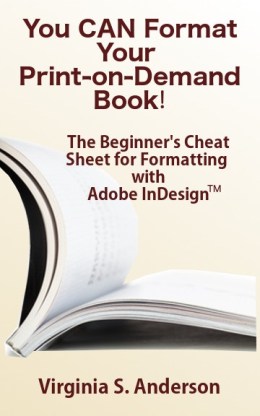
You CAN Format Your Print-on-Demand Book!

You can do it! I did!

Leave a comment

Filed under Amazon Kindle Direct Publishing, book design for creative writers, business of writing, Free Books, indie publishing, Print on Demand for fiction writers, Publishing, Self-publishing, Writing, writing contests, writing novels

Best and Worst Self-Publishing Services Reviewed & Rated by the Alliance of Independent Authors (ALLi)…

Comprehensive list from the Alliance of Independent Authors! Thanks to Chris the Story Reading Ape for providing this link!

Chris The Story Reading Ape's avatarChris The Story Reading Ape's Blog

The Watchdog Desk of The Alliance of Independent Authors monitors the self-publishing industry in two ways.

1. We have a Partner Membership for services which align with our Code of Standards and go through a vetting process.

2. We identify rogue services which overcharge, over-promise, under-deliver, or in any way exploit authors.

The ratings below are the opinion of the Watchdog Desk. Ratings are based on careful appraisals of multiple criteria, including pricing and value, quality of service, contract terms and rights, transparency, accountability, and customer satisfaction.

See the full list and details HERE

View original post

Leave a comment

Filed under business of writing, indie publishing, Print on Demand for fiction writers, Publishing, Self-publishing, Writing, writing novels, writing scams

How to Evaluate Small Publishers—Plus Digital-Only Presses and Hybrids – by Jane Friedman…

Thanks to Chris the Story Reading Ape for making this terrific Jane Friedman article available! I’m closing in on the decision as to whether to self-publish or go the traditional route with a small press, so this article is a godsend!

Chris The Story Reading Ape's avatarChris The Story Reading Ape's Blog

In my annual chart,The Key Book Publishing Paths, there is one column that is most vexing and problematic for writers to navigate: small publishers.

Into this category falls some of the most prestigious publishers you can imagine, that can boast of New York Times bestsellers, and that writers dream of working with.

But it also includes publishers that started up last year out of someone’s home office, run by people who may not know anything more about the publishing industry than you do.

Continue reading HERE

View original post

2 Comments

Filed under business of writing, ebooks publishing and selling, indie publishing, Money issues for writers, Myths and Truths for writers, Print on Demand for fiction writers, Publishing, publishing contracts, reversion of rights clauses, small presses, Writing, writing novels

Avoid Rookie Mistakes When You Format Your POD Book!

Joel Friedlander tells us about the formatting mistakes that make your book look like you made it in your garage. You CAN Format Your POD Book: The Beginner’s Cheat Sheet for Formatting with Adobe Indesignshows you how to fix these mistakes. Check it out!

You CAN Format Your Print-on-Demand Book!

Leave a comment

Filed under book design for creative writers, business of writing, indie publishing, Print on Demand for fiction writers, Publishing, Self-publishing, Writing, writing novels

Working on Your First Page? Here’s Good Advice

Writers in the Storm often supply good lessons. This is a particularly cogent first-page critiqueWoman writing that takes aim at some my worst foibles: too many metaphors, authorial intrusions, details readers don’t need, details they do need–what about you? How would you rate this first page?

2 Comments

Filed under Editing your novel, indie publishing, Learning to write, Plot Development for writers, Print on Demand for fiction writers, self editing for fiction writers, Self-publishing, style for writers, Writing, writing novels

Something Fun! “Hemingway” Does Hemingway!

Via Jane Friedman and Dave Chesson at Kindlepreneur, I came across this delightful exercise from The New Yorker. Dave had reviewed four top “editing” programs, Grammarly, Ginger, Hemingway, and ProWritingAid. He linked to an article in which writer Ian Crouch takes Hemingway the App on a spin in Hemingway’s actual prose.

Apps for editing writing

Do these apps cut the fog from our writing?

You probably know somebody who claims to write like Hemingway (I do). Or who claims to want to write like Hemingway (I sometimes do). So it’s interesting to see that Ernest’s scores vary from a bad, bad 15 to an excellent 4—which means a fourth-grader could understand it— depending on which text you choose. Crouch’s analysis of a passage from The Sun Also Rises also shows how sometimes it’s the broken rules that make a passage work.

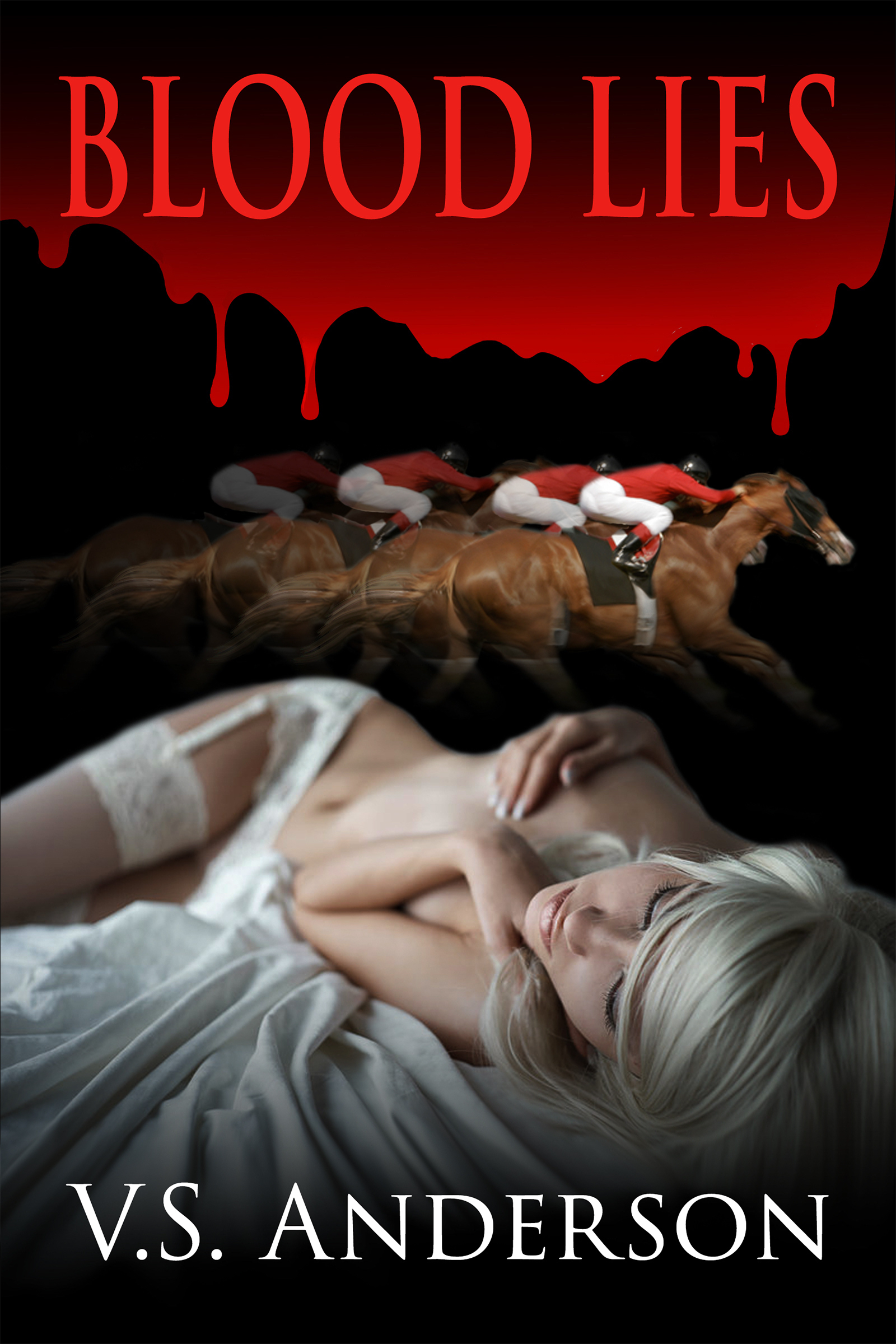
Hemingway the App has a free online editor you can play with. I thought that would be fun as well. In general, I find these editing apps annoying, not least because they miss some really basic stuff. For example, in the first page of my novel Blood Lies, published by Bantam/Doubleday way back when and republished by me online, the sentence that is tagged as VERY HARD TO READ (bad, bad, really bad) is actually two sentences connected with a semicolon. Yes, I know some people think there’s a rule: no semicolons. I’m not there yet.

On the other hand, I do find that much of my line editing involves simplifying those sentences that rolled so sonorously through my head when I wrote them. I find that I’ve become more skilled at hearing the ones that need a weed trimmer taken to them. The trick is to give yourself some distance from your prose and come back to it with a stranger’s ear, as much as possible.

In any case, here’s my annotated page with the Hemingway comments. They gave me a Readability grade of 3, only “good.” Crouch says, “The app suggests that anything under Grade 10 is a sign of ‘bold, clear writing.'” Maybe my writing is too simple! See what you think.

Key:

red—adverbs (I am supposed to cut one);

yellowish—my 4/51 “hard to read” sentences;

green—passive voice (they say I’m okay with only 3, but I take exception to “was scorched’; “scorched” is a predicate adjective in this construction;

purple—my VERY BAD HARD TO READ sentence. But I had only 1.

MY PAGE

Two days and a night. Bitter roadside coffee, the slimy stars of dead moths on the windshield. Poisonous truck fumes on 1-75. An hour’s fitful sleep in the back seat of the Firebird, an hour in which he dreamed that it was Holyhead that had burned.
 
He had never been to the trailer, but he knew exactly where it was. Alejo had said, “You know the big tree in Langston’s south pasture that lightning hit? Just down the hill from that, on the corner.” And Ted had answered, “Oh, yeah.”
 
Alejo spent every spring and fall in the fancy doublewide on the small square of land. “Now I am so rich,” he said, “all America is my home. But Keeneland Racetrack was always good to me. I will always ride there. Even when I am more famous than Willie Shoemaker, I will always go back to Kentucky.”
 
“Yeah,” Ted had answered. “And maybe one day Lexington will elect you mayor.”
 
“A statue in the paddock at the racetrack is all I ask.”
 
Alejandro Asolo had not earned his statue. He had not become more famous than Willie Shoemaker. He had not had time.
 
Ten years ago, Ted’s thirteenth summer, three broodmares had been killed when lightning struck that tree in Langston’s pasture. He found the trailer easily. Very little had changed.
 
The cops had stretched a large sheet of black plastic on the trodden grass. On the plastic they were dumping small, charred piles. Ted could not believe the framed win picture had survived. He reached to pick it up. It was scorched, blistered, but the row of familiar faces grinned bravely through the soot: Alejandro’s, Teresa’s, Sunny’s, his own.
 
One of the policemen turned and saw him. “Hey! Put that down!”
 
He straightened. The cop waved a buddy over and they both advanced, arms held out from their sides.
 
“Something we can do for you?” one of them asked. He had round, soft-looking cheeks, and a plump, pursed mouth, but his hard little eyes glinted under his hat brim.
 
Ted dropped the picture wearily at their feet. “I’m looking for Mrs. Asolo.”
 
“She’s gone. What’s your name?”
 
“I was a friend of Asolo’s. I drove up from Miami when I heard.”
 
“Friends got names,” the cop said.
 
He could smell it. He had told himself the spring wind and the harsh overlay of charred wood, fused metal, and melted plastic would have carried it off, but he had been wrong. He stepped backward, groping behind him. Maybe the fat-cheeked policeman thought he was bolting; he shoved him back against a tree. But the other policeman, a younger, leaner man, said, “Sit down on the ground a minute, kid. Put your head between your knees. You’ll be okay.”
 
The inner walls of the trailer had been reduced to gummy filaments; the cops sorting the rubbish brushed them gingerly aside, shaking their hands afterwards, as if freeing themselves from cobwebs.
SEND ME YOUR SCORE FOR THIS PAGE!

Leave a comment

Filed under Blood Lies, Editing your novel, grammar rules for writers, indie publishing, Learning to write, Myths and Truths for writers, Print on Demand for fiction writers, self editing for fiction writers, Self-publishing, style for writers, V. S. Anderson, Writing

Common Book Marketing Traps to Avoid…

Some useful advice from marketing expert Penny Sansevieri via Chris the Story Reading Ape. A reminder to me to a) get more proactive about marketing, and b) to get that next book out. I’ll go work on that now!

Chris The Story Reading Ape's avatarChris The Story Reading Ape's Blog

By Penny C. Sansevieri  on Book Works:

There’s a ton of information out there for indie authors. However, there is also a lot of misinformation, too, as well as outright lies about book marketing. And indie authors are left in the cold to sort through the truths, semi-truths, and non-truths for themselves. Which means that you may end up figuring out the best path through trial and error, falling into common book marketing traps in the process.

Because I believe that empowering authors to follow the best practices elevates the whole industry, today, I’m taking some time to set the record straight.  Indie authors, read on to learn some of the biggest book marketing traps and pitfalls and how to navigate around them for the best success.

Continue reading HERE

View original post

Leave a comment

Filed under business of writing, indie publishing, Marketing books, Money issues for writers, Myths and Truths for writers, Print on Demand for fiction writers, Self-publishing, Writing, writing novels