Hear, hear. One of the silliest rules people pass around. I particularly like the way Derek’s examples show how moving the adverb around changes meaning.
I’d add two points. One, “to boldly go” sounds so right because it’s iambic pentameter, one of the most natural rhythms for spoken English (Shakespeare’s meter).
Second, many “rules” like this evolved because 17th- and 18th-century pedants wanted to “improve” English by making it behave like Latin–ignoring the fact that English falls into an entirely different class of language than Latin. But hey, if Latin (one-word) infinitives can’t be split, we shouldn’t split English infinitives, either, even if they are two words.
Thanks to the Story Reading Ape for sharing this useful post!
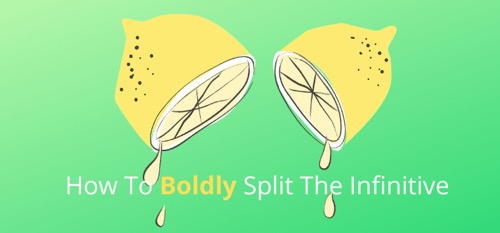
Almost every style guide will tell you should avoid the split infinitive.
But is this generalised rule always valid?
We all know the famous Star Trek example of breaking the rule: to boldly go where no man has gone before.
It would sound awkward if I applied good English grammar. My grammar checker correction says it should read: to go where no man has gone before boldly.
I’d saved this post from earlier and have just checked in. Harnby has a wonderful way of explaining clearly, with good examples. Not only did she note a problem I see often (U.S. writers thinking that “distanced” words should be in single quotes), but she also told me something I didn’t know, and I’m a grammar geek: that U.K. editing places quote marks inside the punctuation in nested quotes. I’d seen that practice but hadn’t made the leap to generalizing to the rule. Use this guide whenever you wonder what to do with those annoying ” and ‘ marks.
Here’s how to use quote marks (or speech marks) according to publishing convention in your fiction writing. The guidance covers both US English and UK English conventions.
In this post, I cover the following:
What quote marks are used for
Omitting a closing quote mark in dialogue
Whether to use single or double quote marks
Whether to use straight or curly quote marks
Where the closing quote mark goes in relation to other punctuation
This piece accords with my experience. I haven’t used the “pro” versions of editing software, so maybe they would work better than the free versions, but I’ve found that the suggestions are wrong as often as they are right. Here’s a quote from the article that I agree with:
“A person with no knowledge of grammar will not benefit from relying on Grammarly or any other editing program for advice. There is no way to bypass learning the craft of writing.”
Do you agree? If not, why not?
A number of people have asked me about editing programs, and if I use them in my own work. I do–but also, I don’t.
I rely on my knowledge of grammar and what I intend to convey more than I do editing programs, which are not as useful as we wish they were.
You may have found that your word processing program has spellcheck and some minor editing assists. Spellcheck is notorious for both helping and hindering you.
Spellcheck doesn’t understand context, so if a word is misused but spelled correctly, it may not alert you to an obvious error.
There, their, they’re.
To, too, two.
Its, it’s
Grammarly is an editing program I use for checking my own work, in tandem with Pro Writing Aid. I pay a monthly fee for the professional versions of these two programs. Each one has strengths and weaknesses.
This column from Louise Harnby, via Chris the Story Reading Ape, tackles the recurring problem of how to convey information about multiple characters in a scene without breaking point of view. It’s certainly a problem I struggle with. These are good reminders that there are better ways than “seemed” or “appeared to” to get across what that non-pov character might be up to. Check it out!
If your characters seem or appear to be doing or feeling something – probably, maybe, perhaps – then you might be using half measures to express a good chunk of that action or emotion.
The very first line of your query has to tell the agent or editor how long your book is.
The execrable fact is that they expect certain genres to fall within certain limits.
When you’re an overwriter, like me, always able to stroke out one more metaphor, one more lilting phrase, one more neat character detail, hitting those word limits can be a challenge.
The problem intensifies when your writing groups and betas want “More! More!” Or when they push you to look at issues in your story that you glossed over before but now can’t leave unresolved.
So I faced querying a psychological-suspense manuscript at 107,000+ words and an accidental-detective mystery at 106,000+. I’m here to report that both books are now under 100,000 words.
Victory Lap!
I’ve read enough submissions in writing groups to know that I’m not the only one in need of a repertoire of tricks (okay, strategies) for corralling a manuscript that has bolted for the hills. I needed “Power Cutting” skills.
I know what a lot of us would say: Cut 7,000 words?!? That will destroy my book! My brilliant writing will win over readers no matter how long it is.
Maybe, but you have to get an agent or editor to read your brilliant writing instead of thinking, “That sounds way too long.”
In fact, my efforts taught me strategies, many of them simple fixes, that actually improved my books rather than devastating them.
Not only will these strategies help you catch bad habits, they’ll force you to think hard about your story: What is it about, what belongs and what doesn’t? At least, that’s what Power Cutting did for me.
Here are some of the big-ticket things I learned.
Have a word-count goal. Until you make up your mind that you MUST cut, you won’t. Watching that number at the bottom of the screen sink and sink inspires!
Cut hard now, reconsider later. You might cut too hard and scrape off too much voice, but storing your cuts in a separate, renamed file saves your original language, ready to reinstate after you’ve exceeded your goal.
Remember that no one but you knows what you took out. No one else will miss your golden imagery or your delicate dialogue exchange.
Cut via a complete read-through. You’ll spot problems like repetition that would not show up if you dove in at random, and you’ll maintain the continuity of your story.
Throughout, remember that clarity comes first. Always make sure, for example, that it’s clear who’s speaking before you cut a dialogue tag.
Ask first and last, what does this scene/paragraph/line add?Three cuts to look for:
Work you’ve already done. Yes, certain themes and events should be kept before your readers, but when you find yourself thinking, “Didn’t he already say this?”, he probably did. If there’s no new twist to a scene or interior monologue, it can go.
Dialogue exchanges that don’t further the plot. Banter for banter’s sake, no matter how scintillating, takes up real estate. Dialogue cuts better when it’s sharp.
Piled up details/metaphors/images. In literary fiction, you can interweave whole pages of lyrical description with luscious introspection. In commercial fiction, most paragraphs drag after more than one detail or image, no matter how powerful. Pick the one that does the most work in the fewest and/or most evocative words.
I found some more specific strategies as I progressed with my cutting. I’ll share some of those in an upcoming post.
Everyone should read this! I’ve learned from attending conferences that agents and editors read differently from writing-group colleagues. Until you’re critiqued by an actual agent, you can’t know what works for them in your opening pages. You won’t get that feedback from cold querying, but conferences provide opportunities to learn firsthand how what you’ve written is received.
The pros and cons of an MFA (Master of Fine Arts) in creative writing are widely debated: on one hand, such programs offer students the opportunity to work with accomplished authors, whose expertise (and endorsements) could make all the difference in publishing their first book. On the other hand, such programs often come with a hefty price tag, with fully funded options few and far between.
But regardless of whether you go for an MFA, some things are critical to establishing a career as an author that you probably don’t know, unless you’ve learned them the hard way (or you’ve worked in publishing).
I say this as someone who went for an MFA and then went on to establish a career as both an author and an editor. And this is information I want to circulate widely—first, because I know how hard it is to have…
It’s a plain truth that our eyes skip over typos when we’re proofreading our own work. Words you left out or accidentally cut (or accidentally failed to cut) may be the hardest mistakes to catch. But the good news is that you CAN catch another type of invisible errors: punctuation and spacing glitches that detract from the professional manuscript you want to market under your name.
In this pdf,What You WILL Miss When You Proofread, I’ve combined three blog posts to show you some simple tricks using an old friend, Find/Replace, to search for and fix common typos from double periods to missing quotes. You won’t need any elaborate codes; all the commands you need are right there in the FIND box.
My fixes are based on Word, but you should be able to adapt them to any word-processing program you use.
And now a completely different opinion on whether you can or should replace Word. I’m not the best judge here because my old Word still works fine for me. The phrase “industry standard” does carry some weight; again, it may come down to the question of how many obstacles you want to put between yourself and your prospective agent or editor. What do you think?
When your book is ready for editing, it’s time to pack it neatly into an industry-standard file format. Whether you write in dedicated writing software like Scrivener or key your story into Google Docs after writing it longhand, a finished novel isn’t a private creative endeavor or hobby anymore. Now it’s a product for an industry with professional standards and technical requirements.
If your manuscript is destined for a literary agent, freelance editor, formatter, designer, publisher, or other professional, the standard format is Microsoft Word.
No one knows better than I do the anguish of being an inveterate overwriter. Here are some of the ways my penchant manifests itself:
Stacking up adjectives, sometimes without any particular point other than the love of words. One example at random from my Failed Novel: “By the time he pulled out once more onto 41, the Tamiami Trail, the sun had turned dusty red behind him, piecing out of the sky faint, ominously pendant, pink-tinted blooms of cloud.”
Piling up metaphors and images until I end up with a bean soup of ingredients that don’t always play well together and end up siphoning reader attention away from characters and into the quagmire of the language itself. . . . Need I say more?
Hunting obsessively in thesaurus.com for THE PERFECT WORD so as to avoid settling for what Mark Twain would have called “the lightning bug”—but ending up with a choice (often a verb) that is so far out there that writing groups suggest gently that I probably ought to settle for something a little less . . . well, I’m having to go to thesaurus.com to find THIS right word. “Arresting”? No, that’s not right. Disruptive? Intrusive, contentious, militant. . . . You get the point.
Diving into long passages of introspection in which I explore the character’s relation to life, the universe, and everything from so many directions readers probably feel as if they’re inside a disco ball.
What a dangerous way to write!Here are some of the sad consequences of this indulgence:
Too much verbiage, even the brilliant kind I am so clearly expert at, slows the story pace. Readers emerge from even a page or two exhausted, just wanting to move on—or quit.
Too many details, descriptions, and distractions dilute important moments in a scene so that what should be on display gets lost in the window dressing. Scenes should have a structure that builds to the crucial turn, but overwriting drags out scenes so that every event, line of dialogue, metaphor, or action carries equal weight.
The words themselves start demanding the focus that should go to the characters and their interactions.
The backstory in introspection loses its force when not linked to the characters’ actual experiences in time. If we’re told in a long, over-filled expository paragraph on page 10, among seventy or so other details, that a character had a traumatic experience at age seven, by the time we see that trauma play out on page 100, we’ve forgotten its source. We don’t know about that trauma from being told it exists, but from seeing in the moment what it does.
I’ve seen writing group members defend some pretty egregious excess by insisting that what they’re writing is “literary,” a form in which the language itself becomes the focus rather than the “plot.” I guess there was a time when I retreated behind this rationale myself. But I’ve come to apply terms like “lazy” and “self-indulgent” to pile-it-up-on-the-page writing these days. I confess I’ve arrived at this judgment after seeing how some colleagues’ drafts exhaust me when they do all the things I tend to do.
So the moral here must be “Don’t Overwrite.” Followed by “10 Steps to Avoid Overwriting.” Right?
Umm, not quite.
Instead, I’m going to claim that, in its proper place, your tendency to do all the things I listed above (and more?) is a strength!
So: X Reasons to Love Your Curse.
Actually, there’s one real reason you should value your overwriting impulses: unlike your more verbally impoverished colleagues, you overwriters generate a lot of text! You never have to sit and try to “come up with” an image or a detail. You’ve already poured out a grand effusion of writerly stuff.
This means:
Experimentation! You know you’ll cut four-fifths of what you generate. So you can let the words wander. See where they lead. Mixed metaphor? No problem. It’ll get put to rights—or in its place—in the final cut.
Choice! Somewhere among all those words and sentences and images, there’s one that really produces that scintillating “this is it!” shiver. You just have to clear away the litter that keeps it from doing its job. And don’t throw out all the efforts that didn’t answer this particular need. They aren’t necessarily substandard or failed. They may work perfectly in the scene you’re writing next.
And although all that introspection may not work for your harried readers, it’s your way into your characters. You end up knowing them intimately, as you must if you and your readers are to willingly share their worlds for 99,000 words.
Same with world-building. Too many details? Even if you cut that street-by-street description, you still live in those alleyways and cul-de-sacs in your mind.
And who knows? Maybe you, more than your verbally limited colleagues, actually will one day produce a literary masterpiece. After all, it’s from the piling up of words, images, sentences, that the “voice” that commonly defines “literary” emerges.
The key, of course, is to actually do the CUTTING that converts your curse to a strength.I know how hard it is to hack out those lovely lines that flowed from that sacred font. I’ve found that I finally have to be told, indisputably, that X words have to go. Then it actually starts to become fun to watch how paragraphs firm up, cohere, how fast the lines race by and how hard they slice.
One painful but potentially useful exercise: take a particularly long, detail-and-event laden chapter, and vow to reduce it by one-half. Can’t do it? Try for one-third. Just to see what you get.
(Hmmm. Maybe I should do that with this post. . . . :D)
Do you have strategies that make your overwriting indulgences work for you?

 Almost every style guide will tell you should avoid the split infinitive.








 Just Can't Help Writing