Tag Archives: Self-publishing

Need Your Own ISBN? It’s Easy.

Of course, the first question is, do you need your own ISBN?

The long and short of it is—YES, YOU DO.

Here’s a site that provides a quick and dirty explanation of why indie authors should own their own ISBNs instead of letting Amazon or Book Baby or any of the other packagers give you one for “free.” As the site will make clear, there are hidden costs to this perk.

So if you’re convinced, as I was, how do you get an ISBN?

It’s really not hard at all.

In the United States, ISBNs are sold through a company called Bowker. At http://www.bowker.com, you’ll find a link for “Authors.” On this page, you’ll be invited to click on various links promising help with your project, but for now, you’re interested in the link called “ISBN United States.”‘

Bowker

Next, you’ll click on a link to “Get Started: Order ISBN.”
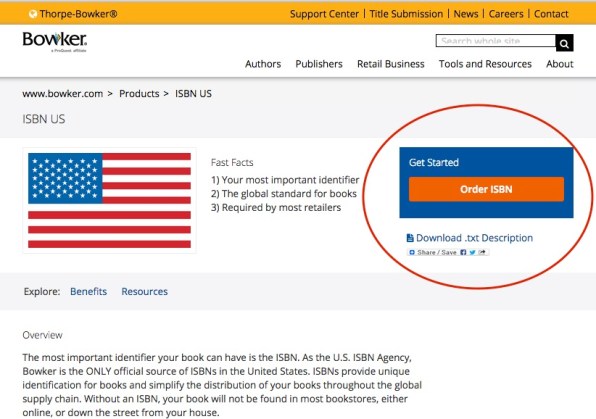
Bowker Order ISBN page

On the next page, you’ll be able to scout the various plans and set up your “MyIdentifiers” account.

Bowker buy ISBN now page

At present, Bowker sells a single ISBN for $125, ten for $295 (they were on sale for $250 the day I wrote this), or 100 for $595. What should you do?

This is another personal choice. Experts online vary in their recommendations, but all seem to agree that most authors will need more than one ISBN. For example, if you buy just one at $125, use it for your ebook in the Kindle Store, then choose to create a POD edition needing its own ISBN, you’ve already spent $250—because each edition of your book requires its own ISBN. Most indie authors publish more than one book. Many publish more than ten books! How many books you expect to write will probably dictate the choice you make.

Note that the page offering you the ISBN options also offers you a chance to purchase a bar code. This code will eventually go on the cover of your POD book, providing the ISBN and the price you set for your book.

You can delay the bar-code purchase until you are actually ready to produce your cover. When you buy your ISBN(s) and create your Bowker MyIdentifiers account, you will find a link allowing you to purchase the appropriate bar code for that ISBN.

Bowker Manage ISBNs page

When you buy a bar code, your MyIdentifiers screen at Bowker will allow you to set the price that will appear on the bar code.

I chose to set this price to zero. Why? Because if you later want to change the price for any reason, you must produce a new cover with a new bar code. Uploading this new cover will cost you $25.

However, if your bar code reads “zero,” you can price the book any way you want, and other sellers can attach their bar codes over yours or charge whatever they want.

You will still set a retail price at Ingram for individual purchasers. Bookstores who might order your books to sell on their shelves get their discounts based on this price. At Ingram, you can edit both the price and discount over time if you like.

Bowker seems set up to accommodate even the most uneducated users. Like all technology, it requires you to follow a set of steps, but in the long run, negotiating these steps will give you the control you want over your work!

5 Comments

Filed under business of writing, indie publishing, Print on Demand for fiction writers, Publishing, Self-publishing, Writing, writing novels

Lies told by Small Presses

Some good warnings to take to heart!

I have a couple of things to add. Unless the market has changed drastically, having a good agent and getting an advance is unlikely to guarantee your book visibility or even entry into mainstream bookstores. I was paid $5000 by St. Martin’s in 1983; even though King of the Roses got superb reviews (check them out in the Amazon preview), the book never made it into any of the many stores, local or national, that existed at the time (before Amazon). I was told St. Martin’s would have had to commit to a massive advertising budget before any of the stores would find spine-out space for my book, let alone any kind of display or prominent position. (This despite the fact that my mother wrote many angry letters to bookstores demanding that they put my book on a stand in the doorway!) St. Martin’s did minimal advertising, but did make sure reviewers got copies and paid attention to them, which is a big deal, and something that will be hard for us to do for ourselves.

It’s my understanding (possibly erroneous?) that publishers’ budgets are even tighter today than they were in 1983. So true traditional publishing by one of the major houses doesn’t mean authors don’t still have work to do to get their books out there. But articles like this help us avoid pitfalls that will make our efforts go for naught!

Steven Capps's avatarBard & Books

Like many of my posts, this stems from something I saw in an online writer’s group. Essentially, someone who has been traditionally published from a small press was putting down people who self-publish. Personally, I have my own problems with self-publishing that I discuss in my “Why I’ll Never Self-Publish” post, but that is besides the point. At this point, I’d like to formally begin my rant against small presses.

In my opinion, traditional publishing is best done through an agent and then with a professionally recognized publisher. Small presses, unless they are recongized by writing organizations like Codex or SFWA, often give little more than what someone can do through self-publishing but will suck away 40-60% of the author’s share of royalties and then use self-publishing tools (like Createspace) to produce the book. Small Presses get away with this by telling authors lies in order to get them to sign…

View original post 1,144 more words

2 Comments

Filed under business of writing, indie publishing, King of the Roses, Marketing books, Money issues for writers, Myths and Truths for writers, Publishing, publishing contracts, Self-publishing, small presses, V. S. Anderson, Writing, writing novels, writing scams

7 Rookie Writing Mistakes (and 7 Ways to Improve)

The “7 Rookie Mistakes” from Phoebe Quinn over at A Writer’s Path ring true. For example, I agree we tend to recycle clichéd characters from other things we’ve read or TV we’ve seen. It’s because we do this that literature in all its forms has such a profound effect on our values. We think “heroes” MUST behave like the hero in a popular book or that people who behave like the villain we just saw on Netflix are also villainous. It’s tough in writing to catch yourself scribbling in these “types.”
What do you think of Quinn’s fixes? I’m still a pantser, and I do pay the price—but I want to be surprised by my own writing, and outlines take that surprise away.

theryanlanz's avatarRyan Lanz

pencil-7-writing

by Phoebe Quinn

7 rookie writing mistakes:

View original post 1,042 more words

1 Comment

Filed under ebooks publishing and selling, Editing your novel, genres for writers, indie publishing, Learning to write, Myths and Truths for writers, Plot Development for writers, self editing for fiction writers, Self-publishing, Writing, writing novels

Author Beware … Publishing Predators Are Breeding…

Thanks, Chris, for another important article. Here is my comment on this article at The Book Shepherd:
I’m amazed that so many people will pay these sums to be published when CreateSpace will do it for free. All you need is a Word file and a cover. Sorry, my CreateSpace book looks just fine. I suppose there are genius cover designers out there who could have done a better cover than DigitalDonna.com did for me, but I’d be surprised to discover them at a reasonable cost.

I went with Ingram first; again, nothing wrong with the 22 books I purchased at cost ($168). At Ingram, you will pay $49 for publication, and you must, indeed should, buy your own ISBN, since if you choose CreateSpace first, they will own the ISBN. Three hundred dollars for 10 ISBNs you can use for your entire series is a lot less than the numbers being discussed in these comments.

I formatted my own interior, which cost me $20 a month for my subscription to Adobe InDesign. On my blog [this blog!], I’m doing a series on how I conquered InDesign.

Believe me, it’s not that hard.

I hope writers will use the funds they are paying for these services to find good professional editors and cover designers. And I second Judith’s point that being traditionally published does NOT mean that you will get stellar marketing. In the end, you will do that for yourself. Why not do it all?

(And I second a comment that recommended Smashwords. Not only will Mark Coker walk you through the ebook-creation process, he will publish your ebook absolutely free!)

What about you? Do you have any tales to tell about your publishing adventures? Help us all “beware.”

Chris The Story Reading Ape's avatarChris The Story Reading Ape's Blog

img_7794

Article extract from Judith Briles on The Book Shepherd site:

Oh, what a tangled web they weave … publishing predators are breeding with the surge of authors now by-passing traditional publishing. Over half of books published today are by the self and indie publishers. Traditional publishers are taking notice and are now gearing up to offer their own “self-publishing” opportunities. Some, like Simon & Schuster, Hay House and Penguin, have had a “vanity press” relationship for years in place via Author Solutions (ASI). Expect to see all of this push into a higher gear–after all … there is money in wannabe author’s pockets.

It’s a never-ending story … the emails, phone calls, postings within the Author U Group on LinkedIn and my personal group on Facebook: Publishing with The Book Shepherd (join it) … and I’ve worked with several private clients and fielded numerous phone calls/emails from authors who have…

View original post 22 more words

Leave a comment

Filed under book design for creative writers, business of writing, Editing your novel, indie publishing, Marketing books, Money issues for writers, Myths and Truths for writers, Print on Demand for fiction writers, Publishing, publishing contracts, Self-publishing, Writing, writing novels, writing scams

What’s your favorite punctuation mark? And the one you hate?

The five basic comma rulesHere’s a great article for you punctuation police to agree or argue with. My personal favorite is the comma. Used intelligently, commas are wonderful signposts that tell readers which part of a sentence they’ve stumbled into—and then help them make their way out again. I like commas so much I wrote an entire post about them.

If comma rules confuse you, take heart! If improving reader comprehension is your goal, there are really only a few “rules” to remember:

Use commas:

  • After introductory elements.

This is the one most people seem to know about. But I argue that commas are really only necessary when the introductory element gets long enough that readers may miss the lane change back into the main part of the sentence.

So:

After a moment he left the room. (No comma needed unless you want to emphasize a pause.)

But:

After he spent  an extended vacation in a remote village in the Alps, where did he go next? (The comma lets readers  know that “where” begins a new clause.)

  • Around “interrupters,” including non-essential modifiers.More comma rules

I think this one is the most confusing for many writers.

Short interrupters can be easy to spot:

Jane, however, did not go with him to the Alps.

Non-essential modifiers are elements that can be lifted out of the sentence without compromising its meaning or purpose.

The old car, which was a lot like the one my grandfather used to drive, had been repainted bright blue. (The rule here, and it is a rule, is either two commas or none. You need that second comma to signal the return to the main clause.)

Here’s an example of an essential modifier, one that can’t be lifted out without turning the sentence into nonsense. (I often see commas inserted into constructions like this.)

Author Stephen King wrote a lot of books.

Note: no commas. Now try it without the essential modifier, in this case an appositive:

Author wrote a lot of books.

  • Direct address (this is also a rule, not an option):Do you need the Oxford Comma?

Hi, Mr. Smith.

Did you buy bread at the store, Louise?

Louise, did you buy the bread?

  • Before “and,” “but,” etc., if you have more than two items. (This is the Oxford or serial comma Pinker discusses in the article I’ve linked to, and his examples of the power of this punctuation mark are good ones.)

If you have only two items linked by “and” or “but,” you have a compound and don’t need a comma, as in this sentence (and note the comma after the introductory clause).

  • Before the “and” or “but” if you’re joining two complete sentences.

I’d argue this is a judgment call, but again, as in this sentence, judicious use of the comma in a compound sentence like this one can provide valuable information about which part of the sentence a reader has ventured into.

{Note commas after the introductory element and around interrupters in this sentence. Commas can keep those elements distinct, so that they make sense.)

That’s five “rules” to absorb—not really so many. Rule Number Six: if one of those five rules doesn’t apply, DON’T INSERT A COMMA. No commas between subjects and their verbs, no commas after “and” or “but,” and so forth. List the five rules and check your questionable comma to see whether one of these applies*:

  • After introductory elements
  • Around interrupters
  • In direct address
  • Before “and” or “but” in a list of three or more items
  • Before the “and” or “but” in a compound sentence (two complete sentences joined with a coordinating conjunction like “and” or “but”**).Check the five basic comma rules

*There are some “conventional” rules for commas that don’t really affect readers’ comprehension, such as the comma that should follow the name of a state (“Austin, Texas, was his home.”) or the ones before and after the year in dates. Any handbook will answer your questions about those minor comma uses.

**There are actually a number of coordinating conjunctions in addition to “and” and “but,” and the rule applies to them as well, but I didn’t want to muddy the waters too much. The other coordinating conjunctions you’re likely to use include “for,” “nor,” “or,” “yet,” and “so.”


5 Comments

Filed under correct grammar for writers of fiction, Editing your novel, grammar rules for writers, Learning to write, Myths and Truths for writers, punctuation for writers of novels, self editing for fiction writers, style for writers, Writing

5 Legal Terms Every Author Should Know…

We never hear this enough! Thanks, Chris!

Chris The Story Reading Ape's avatarChris The Story Reading Ape's Blog

Extract from an article by Writer and Lawyer Helen Sedgwick:

What is the worst mistake an indie author can make?

A bad book cover? A poorly edited manuscript? A hokey website?

No. It’s losing control over your work.legal terms

Pause and Read the Fine Print

Your work is valuable property, just like your car or home. You wouldn’t hand over your car keys to a stranger you met on the internet. You wouldn’t let someone with a slick website move into your guest room. Yet, every day, writers click ACCEPT to contracts with self-publishing companies that take too much control over the author’s work.

Why? Because they can’t bring themselves to read the fine print.

If you are like most people, online contracts with all those legal terms look like 5000 words run through a blender. My goal is to show you where and what to look for, so you can…

View original post 20 more words

4 Comments

Filed under business of writing, Copyright for writers, ebooks publishing and selling, indie publishing, Money issues for writers, Myths and Truths for writers, Print on Demand for fiction writers, Publishing, publishing contracts, Self-publishing, small presses, Smashwords, Writing, writing novels

Do You Need the Oxford Comma? See What You Think!

Do you need the Oxford comma?Here’s a discussion of that often maligned—or at least, often ignored—punctuation mark, the Oxford or serial comma. Disclosure: I believe in the Oxford comma and never leave home without a bagful.

However, do note that when you have only two items in a series (a compound), you DO NOT need a comma before the coordinating conjunctions (usually “and” or “but”). So sayeth Virginia. What sayeth you?

(BTW, if you haven’t encountered the Freelancers’ Union, you might want to take a look. They provide support for independent contractors and single proprietors of all stripes!)

Here’s an extra comma, in case you’re out! Do you need the Oxford Comma?


Leave a comment

Filed under correct grammar for writers of fiction, Editing your novel, grammar rules for writers, indie publishing, Learning to write, Myths and Truths for writers, punctuation for writers of novels, self editing for fiction writers, Self-publishing, style for writers, Writing

Great Advice from The Book Designer blog!

Joel Friedlander at The Book DesignerBook open to the stars is always a wonderful source. This piece by Judith Briles (@mybookshepher) on “How to Avoid Book Publishing Blunders, Bloopers and Boo-Boos” has some up-front advice for all of us. I especially like the “writer beware” section on “pitch fests.” Briles says save your money!

Leave a comment

Filed under business of writing, ebooks publishing and selling, indie publishing, Marketing books, Money issues for writers, Print on Demand for fiction writers, Publishing, publishing contracts, reversion of rights clauses, Reviews, Self-publishing, Writing, writing novels, writing scams

How To Set Up An Amazon Giveaway

Just what I needed! I was hovering over the Amazon Giveaway screens for King of the Roses and discovered I didn’t know how the odds-setting worked. This post, from February of this year, explains it! This is Nicholas Rossis’s “secondary blog” that shows a reblog button, but you can access the original, with many informative comments, here. Now watch for my Giveaway, coming up next week!

Nicholas C. Rossis's avatarNicholas C. Rossis

Amazon has recently started offering everyone the opportunity to offer a giveaway. What’s interesting about this is that you can run one for pretty much any item in their inventory – except for ebooks. So, you can run a giveaway for your print edition, but not your Kindle one.

Alternatively, you could go all the way and offer people, say, a Kindle. Or, indeed, an item that is somehow related to your books. For example, if you’ve written a cookbook, you may give away kitchen gadgets or aprons. The key here is to be imaginative and original.

So, how would you go about it? Here’s the complete how-to.

Step 1: Find your book

Right after the reviews, you will see a “Set up an Amazon Giveaway” button. If you can’t find it, press Control-F (for Find) on your browser and enter the word “giveaway”…

View original post 645 more words

6 Comments

Filed under Amazon Kindle Direct Publishing, business of writing, ebooks publishing and selling, Free Books, indie publishing, King of the Roses, Marketing books, Money issues for writers, Print on Demand for fiction writers, Self-publishing, Tech tips for writers, V. S. Anderson, Virginia S. Anderson, Writing, writing contests, writing novels

My Inerview is up at Don Massenzio’s site. Go admire my sweet Paddy!

Paddy, my horse.Check out my writer’s interview, now available at Don Massenzio’s site! This was a lot of fun to write.

Leave a comment

Filed under blogging, Blood Lies, ebooks publishing and selling, indie publishing, Interviews, King of the Roses, Print on Demand for fiction writers, Publishing, Self-publishing, style for writers, V. S. Anderson, Virginia S. Anderson, Writing, writing novels