Tag Archives: creative writing

EDITING 101: 52 – Adjectives – and the Commas That Go With Them…

Susan Uttendorfsky of Adirondack Editing is back with a post about a punctuation “rule” most of us probably aren’t even aware of—even though we sort of know how to apply it. It’s fun to play around with what “sounds right” to native speakers and speculate as to why.

I’ve argued that you really need only five comma rules to use commas “correctly,” but as Susan points out, commas have other roles, such as controlling emphasis. Commas are strategic tools for writers.

Can you have too many? Absolutely, if they’re inserted where their only role is to interrupt your text. Actually, if you can apply my five rules, you’ll never be “wrong.” Hardest to apply? I’d argue that it can be tricky for some of us to recognize when an element like a non-essential modifier begins and ends.

So what are the comma dilemmas that drive you nuts? Let me  know!


Chris The Story Reading Ape's avatarChris The Story Reading Ape's Blog

Originally posted as the Dun Writin’—Now Whut? series on this blog, EDITING 101 is a weekly refresher series for some of you and brand new for others.

Courtesy ofAdirondack Editing

Adjectives – and the Commas That Go With Them…

So, you’re merrily typing along and your character wants to put on a blue, silk, handmade scarf. Oh, wait a minute. Is that a silk, blue, handmade scarf or a handmade, silk, blue scarf? A blue, handmade, silk scarf? Oh dear!

Aha! Super Editor to the rescue!

(Imagine me swooping over your house and flying in your window, red pen in hand!)

(Ok, now imagine me 10 pounds lighter. Another ten. Ok, that’s better.)

Adjective order in English is not completely random, although what we’re going to discuss are more along the lines of guidelines rather than rules. The exception is when you’re speaking of words of general description along with words…

View original post 471 more words

1 Comment

Filed under correct grammar for writers of fiction, Editing your novel, grammar rules for writers, indie publishing, punctuation for writers of novels, self editing for fiction writers, Self-publishing, style for writers, Writing

Great New Post from Chuck Wendig (a writer you want to meet if you haven’t)

KnowledgeI’m back from knee surgery and scanning my blogs. Not surprisingly, here’s a keeper. Chuck is a lively writer, so there may be some bad words. Well worth it. Here he tells us what I had to learn the hard way; that character, not plot, creates story. My favorite line from this piece–“Plot is the thing that characters poop.”


I learned this in My Failed Novel (here’s one of several posts on How Not to Write a Failed Novel, all of which I’m sure will help you become the Next Big Thing). I forced my characters to do something they most certainly did not want to do. The single good thing about that moment was that I had clearly created characters with lives of their own. I shoved them into action, and they rebelled, and a whole lot of important reviewers saw them rebelling. And said so in the highest venues. The End.

Sad Editing!

Chuck says “give your characters something to do.” I’d add that, if they have come to life, often what they do will not be what just anyone would do. It will often be a choice specific to them, to who they have become as you watched them and listened to them. Not all your readers will admire their choices. But those choices—motivated, yes, by who they are and the context, but at the same time personal, heartfelt, unique—will trigger the next cascade of actions that we think of as plot. So don’t settle for what the latest TV hero would have done. Set loose a character with the voice to tell you what SHE is going to do. Then get out of her way. Plot will be what ensues.

Book open to the stars

Leave a comment

Filed under Editing your novel, indie publishing, inspiration for writers, Learning to write, Myths and Truths for writers, Plot Development for writers, self editing for fiction writers, Self-publishing, What Not To Do in Writing Novels, Writing, writing novels

The Benefits of Joining a Writers Group

As a member of a long-running face-to-face group and now an active online group, I can attest to the truth of what Cynthia Hilston says below: that good groups exist. I spent far too many years writing in isolation; never again. Maybe I don’t like every response; maybe sometimes I’m disheartened. But I’d rather be disheartened now when I can figure out what to do about the problem than when I get that “we’re not the right agency for this project” form letter with NO feedback as to why.

I’ve posted about my group several times (for example, see “In Praise of My Writing Group“), and I did a series on the founding of our group, the Green River Writers, and its leader, Mary (Ernie) O’Dell, here in Louisville.

And I just posted the 2017 Contest brochure for this year’s Green River Writers contest! A terrific contest with low entries fees and lots of cash prizes! Check it out!

2 Comments

Filed under Green River Writers, Learning to write, What Not To Do in Writing Novels, Writers' groups, Writing, Writing and Learning, writing contests

CONTEST! CONTEST! CONTEST!

Green River Writers Logo

Poetry and Prose Categories, Low Entry Fees, Cash Prizes! For information, email contest@greenriverwriters.org

GREEN RIVER WRITERS, here in my neck of the woods, has opened its annual contest.

Two grand prizes @ $175 for first place, 13 other categories all with cash prizes, $3 entries.

http://www.greenriverwriters.org

Green River Writers 2017 Contest Brochure


Leave a comment

Filed under Green River Writers, poetry, Writers' groups, Writing, writing contests, writing novels

Stupid Advice about Writing? Check This Out!

Figuring out if you're a writer: A drive into the dark!

Dodging the glare of negative advice!

Louie Cronin writes for Writer Unboxed: an inspirational tale for all of us who’ve wondered if we’re kidding ourselves about being writers. I especially love her list of things she recommends we deliberately ignore! Enjoy!

Leave a comment

Filed under inspiration for writers, Myths and Truths for writers, Writing, Writing and Learning, writing novels

Do you know how to publish an ebook with pictures?

Source: Do you know how to publish an ebook with pictures?

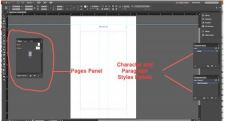
Workspace in InDesignHere’s a post from last fall that I swiped from Jean’s Writing! Now that I’m about to epublish my “Beginner’s Cheat Sheet” on formatting your own Print-on-Demand book using InDesign, I’m going to need all the help I can get on formatting ebooks with graphics! What I like in Jean’s video is the idea that you can force text and image to stay together. Does anyone have any experience adding graphics to Kindle ebooks? Does this look like a good process to you? Any help will be WELCOME!


4 Comments

Filed under Amazon Kindle Direct Publishing, book design for creative writers, business of writing, ebooks publishing and selling, indie publishing, Print on Demand for fiction writers, Self-publishing, Tech tips for writers, Writing

How to Tweet Like a Pro [Lab]

I’m working on developing these practices. Let me know if you have other tips!

Steve Boseley's avatarAuthor Steve Boseley - Darkly Disturbing Fiction

Tweet like a proTwitter is one tool in an author’s bag that can, if used effectively, be utilised to assist in the building of your author platform, which you hope ultimately will result in book sales, plus it’s a great way to make a connection with influencers or to speak to your readers. But a question that was raised in my mind, was:

How do I compose an effective Tweet?

I recently wrote a guest post for Nicholas Rossis’ blog titled What is the best time to Tweet. Choosing the right time to Tweet is definitely an element of what goes into an effective Tweet. Check out that post (when you’ve finished this one!) for guidance.

But for a Tweet to be effective, it involves a lot more than just publishing at the right time, so read on for the anatomy of an effective Tweet.

Content

According to Twitter, there are…

View original post 1,581 more words

4 Comments

Filed under business of writing, indie publishing, Marketing books, social media for writers, Tech tips for writers, Writing

Commas and how to use them (Part 1)

Do you need the Oxford Comma?Hi! Back from an extended adventure. I’ve missed being part of the blogging community.

Below, I’ve shared the first of a really, really comprehensive set of rules about using commas from over at the Story Empire Blog.

I personally love commas; they control emphasis and sentence rhythm and serve as simple traffic signs to tell readers which part of a sentence they’re currently in and when they are changing directions. I’ve posted a bunch about commas on this blog because I love them so much (for example, in “What’s your favorite punctuation mark? And the one you hate?”

And “Commas Control Emphasis. Here’s How!”

My own experience teaching college writing for 25 years led me to believe that reducing the number of “rules” people have to remember is better than trying to explain everything in great detail. Rules tend to make our eyes glaze over.

So, in What’s your favorite punctuation mark? And the one you hate?, I reduced the number of “rules” to five, noting that in some cases, even applying the rule is a judgment call (e.g., note the missing comma after “post” in this sentence and the use of one after “cases”). My five rules for when commas are needed are:

  • After introductory elements (usually)
  • Around interrupters (including nonessential modifiers; always)
  • In direct address (always)
  • Before “and” or “but” (and other coordinating conjunctions) in a list of hree or more items (Long live the Oxford comma!)
  • Before the “and” or “but” in a compound sentence (two complete sentences joined with a coordinating conjunction like “and” or “but”**). (usually)

I note that if you think you might need a comma and it doesn’t fit one of these categories, don’t insert it. Observance of that caution will eliminate a lot of commas between nouns and their verbs!

Stroll over to Story Empire to check out Parts I and II of this post on this most useful and most misunderstood punctuation mark!

Harmony Kent's avatarStory Empire

Hello SErs! Harmony here 🙂 I hope this finds you all well. Today, I’d like to take a look at commas. For such a small punctuation mark, it has a big impact on how well or not our sentences read. Though we use commas a lot of the time, few of us understand them fully.

What is a comma? What does it do?

According to the Oxford English Dictionary: ‘A comma marks a slight break between different parts of a sentence. Used properly, commas make the meaning of sentences clear by grouping and separating words, phrases, and clauses.’

The different types of comma: Listing (Standard or Oxford), Introductory, Joining, Gapping, Bracketing, and other comma uses.

One thing that can make commas so confusing is that sometimes you have options, especially with the Listing and Gapping commas.

Because there is a lot to cover on this topic, I have split it…

View original post 797 more words

3 Comments

Filed under College writing, correct grammar for writers of fiction, Editing your novel, grammar rules for writers, indie publishing, Learning to write, punctuation for writers of novels, self editing for fiction writers, Self-publishing, style for writers, Writing, Writing and teaching writing

Maybe You Don’t Need that Book on Writing After All . . .

Editing tips for writers. . . If you have a computer and can check out Editing 101 at Chris the Story Reading Ape’s blog. Susan Uttendorfsky of Adirondack Editing provides a host of FREE lessons on everything from “Removing Filter Words” (a must-read) to when to use “which” or “that.” I’ve found Susan’s posts to be accurate, clear, and friendly. Check them out!
4 Comments

Filed under correct grammar for writers of fiction, ebooks publishing and selling, Editing your novel, grammar rules for writers, indie publishing, Learning to write, Myths and Truths for writers, Plot Development for writers, self editing for fiction writers, Self-publishing, style for writers, Writing, writing novels

Need Your Own ISBN? It’s Easy.

Of course, the first question is, do you need your own ISBN?

The long and short of it is—YES, YOU DO.

Here’s a site that provides a quick and dirty explanation of why indie authors should own their own ISBNs instead of letting Amazon or Book Baby or any of the other packagers give you one for “free.” As the site will make clear, there are hidden costs to this perk.

So if you’re convinced, as I was, how do you get an ISBN?

It’s really not hard at all.

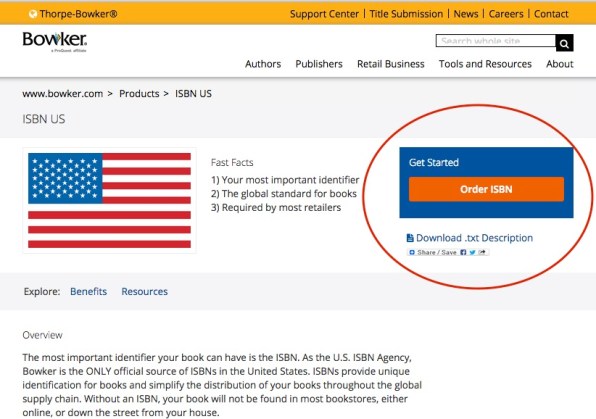
In the United States, ISBNs are sold through a company called Bowker. At http://www.bowker.com, you’ll find a link for “Authors.” On this page, you’ll be invited to click on various links promising help with your project, but for now, you’re interested in the link called “ISBN United States.”‘

Bowker

Next, you’ll click on a link to “Get Started: Order ISBN.”

Bowker Order ISBN page

On the next page, you’ll be able to scout the various plans and set up your “MyIdentifiers” account.

Bowker buy ISBN now page

At present, Bowker sells a single ISBN for $125, ten for $295 (they were on sale for $250 the day I wrote this), or 100 for $595. What should you do?

This is another personal choice. Experts online vary in their recommendations, but all seem to agree that most authors will need more than one ISBN. For example, if you buy just one at $125, use it for your ebook in the Kindle Store, then choose to create a POD edition needing its own ISBN, you’ve already spent $250—because each edition of your book requires its own ISBN. Most indie authors publish more than one book. Many publish more than ten books! How many books you expect to write will probably dictate the choice you make.

Note that the page offering you the ISBN options also offers you a chance to purchase a bar code. This code will eventually go on the cover of your POD book, providing the ISBN and the price you set for your book.

You can delay the bar-code purchase until you are actually ready to produce your cover. When you buy your ISBN(s) and create your Bowker MyIdentifiers account, you will find a link allowing you to purchase the appropriate bar code for that ISBN.

Bowker Manage ISBNs page

When you buy a bar code, your MyIdentifiers screen at Bowker will allow you to set the price that will appear on the bar code.

I chose to set this price to zero. Why? Because if you later want to change the price for any reason, you must produce a new cover with a new bar code. Uploading this new cover will cost you $25.

However, if your bar code reads “zero,” you can price the book any way you want, and other sellers can attach their bar codes over yours or charge whatever they want.

You will still set a retail price at Ingram for individual purchasers. Bookstores who might order your books to sell on their shelves get their discounts based on this price. At Ingram, you can edit both the price and discount over time if you like.

Bowker seems set up to accommodate even the most uneducated users. Like all technology, it requires you to follow a set of steps, but in the long run, negotiating these steps will give you the control you want over your work!

5 Comments

Filed under business of writing, indie publishing, Print on Demand for fiction writers, Publishing, Self-publishing, Writing, writing novels