The Pros and Cons of Prologues

Thanks to Chris the Story Reading Ape for making this visible! I’m of the “do what serves the story school,” and I hate hard-and-fast rules (“Agents hate prologues”). What about you? Weigh in!

M.L. Davis's avatarM.L. Davis Writer

Prologues can be a contentious issue. Everybody has a different opinion on them. I’ve known of readers who love them, agents who hate them, and everything in between! The last novel I wrote started with a prologue, even though as a reader I’m not a huge fan of them. Sometimes you just have to do what works for your novel. But for anyone who’s not sure, I’ve listed some of the pros and cons of prologues below.

The Pros:

You can hook the reader
Prologues tend to be short and sweet, and so it gives you the opportunity to really hook the reader with a gritty opening. You don’t need to introduce the characters involved in any depth, which gives you the chance to create a real air of mystery.

Chance to use a different POV
The prologue doesn’t have to follow the pattern of the rest of your story…

View original post 492 more words

Leave a comment

Filed under Myths and Truths for writers, Plot Development for writers, writing novels

FREE Download: What You WILL Miss When You Edit!

Tricks for finding those pesky little slips your eyes skip when you read.An image for What You WILL Miss When You Proofread; clickable link to the download

2 Comments

Filed under Editing your novel, indie publishing, Print on Demand for fiction writers, self editing for fiction writers, Tech tips for writers, writing novels

3 Critical Things You Won’t Learn in an MFA Program – by Susan DeFreitas…

Everyone should read this! I’ve learned from attending conferences that agents and editors read differently from writing-group colleagues. Until you’re critiqued by an actual agent, you can’t know what works for them in your opening pages. You won’t get that feedback from cold querying, but conferences provide opportunities to learn firsthand how what you’ve written is received.

DeFreitas provides a link as well to a good series on first novel pages. Dig in!

Chris The Story Reading Ape's avatarChris The Story Reading Ape's Blog

on Jane Friedman site:

The pros and cons of an MFA (Master of Fine Arts) in creative writing are widely debated: on one hand, such programs offer students the opportunity to work with accomplished authors, whose expertise (and endorsements) could make all the difference in publishing their first book. On the other hand, such programs often come with a hefty price tag, with fully funded options few and far between.

But regardless of whether you go for an MFA, some things are critical to establishing a career as an author that you probably don’t know, unless you’ve learned them the hard way (or you’ve worked in publishing).

I say this as someone who went for an MFA and then went on to establish a career as both an author and an editor. And this is information I want to circulate widely—first, because I know how hard it is to have…

View original post 77 more words

Leave a comment

Filed under Editing your novel, Finding literary agents for writers, Plot Development for writers, Writers' conferences, writing novels

FREE Download! What You WILL Miss When You Proofread!

It’s a plain truth that our eyes skip over typos when we’re proofreading our own work. Words you left out or accidentally cut (or accidentally failed to cut) may be the hardest mistakes to catch. But the good news is that you CAN catch another type of invisible errors: punctuation and spacing glitches that detract from the professional manuscript you want to market under your name.

In this pdf, What You WILL Miss When You Proofread, I’ve combined three blog posts to show you some simple tricks using an old friend, Find/Replace, to search for and fix common typos from double periods to missing quotes. You won’t need any elaborate codes; all the commands you need are right there in the FIND box.

My fixes are based on Word, but you should be able to adapt them to any word-processing program you use.

Download!

An image for What You WILL Miss When You Proofread

3 Comments

Filed under Amazon Kindle Direct Publishing, book design for creative writers, Editing your novel, indie publishing, Print on Demand for fiction writers, punctuation for writers of novels, self editing for fiction writers, Self-publishing, Tech tips for writers

Writing Software: Why you need Microsoft Word – by Lisa Poisso…

And now a completely different opinion on whether you can or should replace Word. I’m not the best judge here because my old Word still works fine for me. The phrase “industry standard” does carry some weight; again, it may come down to the question of how many obstacles you want to put between yourself and your prospective agent or editor. What do you think?

Chris The Story Reading Ape's avatarChris The Story Reading Ape's Blog

When your book is ready for editing, it’s time to pack it neatly into an industry-standard file format. Whether you write in dedicated writing software like Scrivener or key your story into Google Docs after writing it longhand, a finished novel isn’t a private creative endeavor or hobby anymore. Now it’s a product for an industry with professional standards and technical requirements.

If your manuscript is destined for a literary agent, freelance editor, formatter, designer, publisher, or other professional, the standard format is Microsoft Word.

Continue reading HERE

View original post

Leave a comment

Filed under Editing your novel, indie publishing, Publishing, self editing for fiction writers, Tech tips for writers, Working with literary editors

10 Totally Free Microsoft Word Alternatives For Writers – by Derek Haines…

For years, I’ve used a 2008 version of Word that came with the computer before this one. I’ve successfully uploaded to Smashwords, Ingram, and Amazon using that ancient system. At the same time, my curiosity is whetted. Have you tried any of these programs? Do they work better than Word, and if so, how?

Chris The Story Reading Ape's avatarChris The Story Reading Ape's Blog

on Just Publishing Advice:

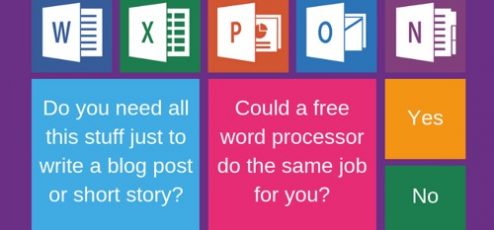
Do you really need all those Microsoft Office programs just to write?

Writers write words. Are you a writer?

I’m sure you don’t prepare business plans with charts and graphs. You don’t use online collaboration tools. You don’t schedule meetings for a group of directors.

I doubt if you would ever need to create business presentations with 100 slides.

You write your words down for blog posts, content articles, guest posts, short stories and maybe poems. So why do you pay for MS Office to do these simple writing tasks?

There is no need to pay for a word processor

Continue reading HERE

View original post

Leave a comment

Filed under indie publishing, Print on Demand for fiction writers, Self-publishing, Tech tips for writers

How I’ve Come to Love Book Pirates

Well, maybe that title is just click-bait. Hope it gets some clicks! Big green smiley

More accurately, my title should read, Why I’ve Quit Worrying about Book Pirates.

Books flying into pirates' hands

Here are a few links you can check out if you’ve heard horror stories (I sort of have some), and/or if you’re interested in this debate:

My quick take—and my reasons for copping out on the anti-book-piracy crusade: Like some of the responders on Kaye’s post, I tried the beta Blasty service. I found myself on sites where I didn’t have the technical knowledge to identify the site owners (Kaye offers some tools to help with this). No address to which to send my own DMCA (Digital Millennium Copyright Act) takedown notice. Some offered their own DMCA form—but every one I completed returned an error notice.

And after I’d spent a whole morning uselessly following Blasty’s leads, I got yet another massive list of all the places where my books could be downloaded for free.

Blasty offered paid services that would send the notices for me. There are other such services; comments on the various articles I’ve linked to above provide some sources, if you want to pursue this route.

But if you read the Guest piece, you may, like me, come away with a sense of “what for?”

“The legal and tech aspects of book piracy prevention are complex and fast-evolving, but those in the know describe it very simply: it’s whack-a-mole. One of the most persistent ebook pirate sites has been taken down multiple times, only to pop back up again under a .com, a .net and a .org domain name. At least 120,000 take-down notices have been issued against it already, involving web crawlers, lawyers, its domain host and the Metropolitan police. But that website is back regardless, complete with some intimidating legal language of its own, addressed to anyone who plans to complain.”

I have read, in more than one place, that many of the “free” sites don’t even have copies of the books they’re selling; they just want people’s credit card info. A lot easier way of taking people’s money than actually scanning books and repackaging them, I suspect.

Who knows? If the big publishers are really losing a lot of money to piracy, maybe they will finally figure out a way to protect their property. And maybe some enterprising soul will pirate their methods and share them with us (in a user-friendly form). Maybe even Amazon will catch on and act. In the meantime, I have other wasteful uses of my time that are a lot more fun than hunting down all those links and filling out a new version of that form ten times a day.

I’m thinking, in fact, about making more of my work (I really do have WsIP!) available for free. The truism Kroese and others offer makes sense to me:

The biggest challenge facing a new author isn’t piracy; it’s obscurity.

So from one so-far obscure writer to others, I’ve quit worrying about people stealing my books. When you read one you like, just be sure to tell your friends.
5 Comments

Filed under business of writing, Copyright for writers, ebooks publishing and selling, Free Books, Marketing books, Money issues for writers, Myths and Truths for writers

Are We Cheating Other Authors by Buying Used Books?

Old Open Bible

This debate featured back in 2016 by Nate Hoffelder on The Digital Reader about the vice and virtue entailed in buying used books—knowing full well that the author receives no compensation—resonated for me because I’ve been feeling guilty about my own Half-Priced Book purchases. I’m not sure I’m feeling less guilty, but at least I know that some defend the practice. The short argument is that used bookstores are where readers are created when they “discover” authors they come to love.

A couple of personal observations:

I’ve long been a fan of Dick Francis (and every horse person and most mystery readers should be as well, IMHO). I reached a plateau where I had overdosed on his formula and quit reading his new ones, and at some point I lost/gave away/never owned copies of his early books, among them some of his best. Off I went one day to my local B&N to pick up new copies and rekindle the relationship. NOT. B&N had none. Not even a recent title, for example those co-authored or authored by Francis’s son Felix in the writer’s final years and after his death.

So off I went to HPB. I was able to find copies of Dead Cert, Nerve, For Kicks, Flying Finish, and many others. Now I often find more recent titles for my bedtime reading and find that Francis is as entertaining as I remember him.

I guess I could buy these on Amazon. Not from Kindle—I hate reading online at bedtime. But am I cheating Francis’s estate, or his son? In my defense, often the earlier titles are available only from third-party sellers, usually used booksellers themselves. What’s more, checking on Amazon for this post, I found that some of the older titles are being released only on Kindle, with all print editions relegated to third-party sources.

I do use HPB and other used bookstores to “discover” authors I might like. I often feel that my reading is too limited and that I ought to be more up to date with what EVERYONE is reading. Every time I venture into the store, I pick up a book by an author I’ve not yet sampled,  sometimes by authors I’ve never heard of, or by authors who have been declared the Next Great Thing. Just to see. If I’m going to toss a book to the floor after forty pages, I’d rather it be a book I paid $3.99 for rather than $29.95.

Will I then pay full price for the next title of an author I like? Hmmm. I did pay full price for a new title by Sarah Waters and might again. But I must confess, I tend to search at HPB first.

I missed this debate when it was supposedly “raging,” but it seems to me worth continuing.

What are your views on Used-Book-Buyers-Remorse?


2 Comments

Filed under Amazon Kindle Direct Publishing, business of writing, Marketing books, Money issues for writers, writing novels

The Ultimate Guide to Writing?

I’m posting this list of writers’ lists of “rules for writing” just for fun. If we read one list a day, we’d be done in 41 days, and who knows what we’d know then that we don’t know now.

On the other hand, maybe we should just start with #42:

42. Phillip Pullman’s One Rule for Writing

“My main rule is to say no to things like this, which tempt me away from my proper work.”

Big green smiley

Leave a comment

Filed under Learning to write

Fake, Pirated And Counterfeit Books A Big Problem On Amazon – by Derek Haines…

Chris shares some frustrating news, but it’s information we should probably all be aware of–if only so that WE don’t end up buying pirated books. Check out Victoria Strauss’s account of her interaction with Internet Archive. But Derek Haines tells us that Amazon is just as guilty—and indifferent (no surprise).

Chris The Story Reading Ape's avatarChris The Story Reading Ape's Blog

on Just Publishing Advice:

Counterfeit books are still a big issue on Amazon

I can only write about the ongoing problem with books.

But Amazon has taken so little action, there could also be a problem with other counterfeit goods.

You could think that identifying counterfeit books would be easy. If you publish a book on Amazon, surely Amazon could at least check for plagiarism when pirates copy your text.

The problem is not new. I have been writing about pirated ebooks and books for a very long time.

Third party sellers are making a lot of money from pirated, fake and counterfeit books.

More importantly, so is Amazon.

Continue reading HERE

View original post

Leave a comment

Filed under Amazon Kindle Direct Publishing, business of writing, Copyright for writers, ebooks publishing and selling, Free Books, Money issues for writers, Self-publishing, writing scams