
Something here for every aspiring writer! Strauss is one of the best resources around! Info on contracts, social media, marketing, promotion—check it out!
Something here for every aspiring writer! Strauss is one of the best resources around! Info on contracts, social media, marketing, promotion—check it out!
Filed under blogging, business of writing, ebooks publishing and selling, Finding literary agents for writers, indie publishing, Learning to write, looking for literary editors and publishers, Money issues for writers, Myths and Truths for writers, Publishing, publishing contracts, reversion of rights clauses, Self-publishing, Writing, writing novels
 Found this at Writers in the Storm today. Here’s what I wrote as a comment:
I had old contracts that required me to give notice and then wait 90 days for the publisher to decide whether or not to re-activate the titles. While I was pretty sure the rights to at least one of the books had already been passed on and then returned to me by another publisher, I went through the steps as laid out in the contracts. The hard part was finding the right place to send my notice. The web site (of a major publisher) was no help. I found a “permissions” link and wrote asking that my request be forwarded to the right person. That eventually happened. and I eventually received written confirmation of the reversion.
The clauses you provide would have saved me a lot of trouble. I’m not sure they were standard when my books were originally published, but for future publications, I’ll be on the lookout! Thanks for some solid advice!
Wish there were more contests for novels or parts of novels! If you have lists of these, please share!
Filed under poetry, Writing, writing contests, writing novels
 We fiction, memoir, and essay writers are all bombarded—understandably—with the need to SHOW, not tell. The temptation to tell rather than show—at its simplest level, to write “he felt sad” rather than letting his actions and dialogue reveal his reactions—haunts us all. It’s easier: We don’t have to hunt for ways to describe expressions and behaviors. And after all, “he felt sad” takes up a lot less space than “The room around him seemed to darken, the sounds of cheerful conversation to slow to dirge-like rhythms.” And hey, will readers interpret such descriptions the way you intended? Maybe the guy is just having a heart attack.
Hardest of all may be recognizing when we’ve slipped into telling. In my writing group, we all get called on it regularly.
One exercise I’ve found extremely useful in helping me recognize telling is the SCREENPLAY exercise: convert a troublesome scene to screenplay format.

Why does this work? For me, it works because, unless you allow yourself the indulgence of a voice-over, filmgoers must rely on action and dialogue to interpret characters’ moods and thoughts and to understand what’s going on.
The rules are simple: at no point in the conversion of your scene can you indicate in your stage directions that “he thought” or “he worried” or “he felt—afraid, tired, hopeful, disappointed.” You may never enter your character’s mind. After all, your audience can’t. They can only see and hear what’s on the screen.
Too stifling? Surely in a mystery, for example, the character has to speculate internally about the meaning of clues. In a romance, the protagonist has to tell us of her ecstasy. Well, maybe. The screenplay exercise can clarify just how much telling we really have to include.
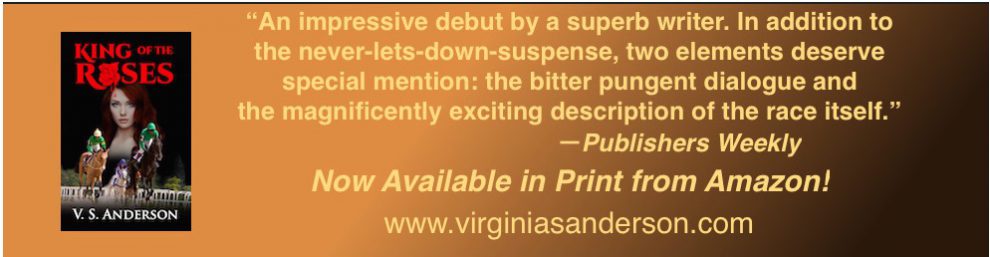
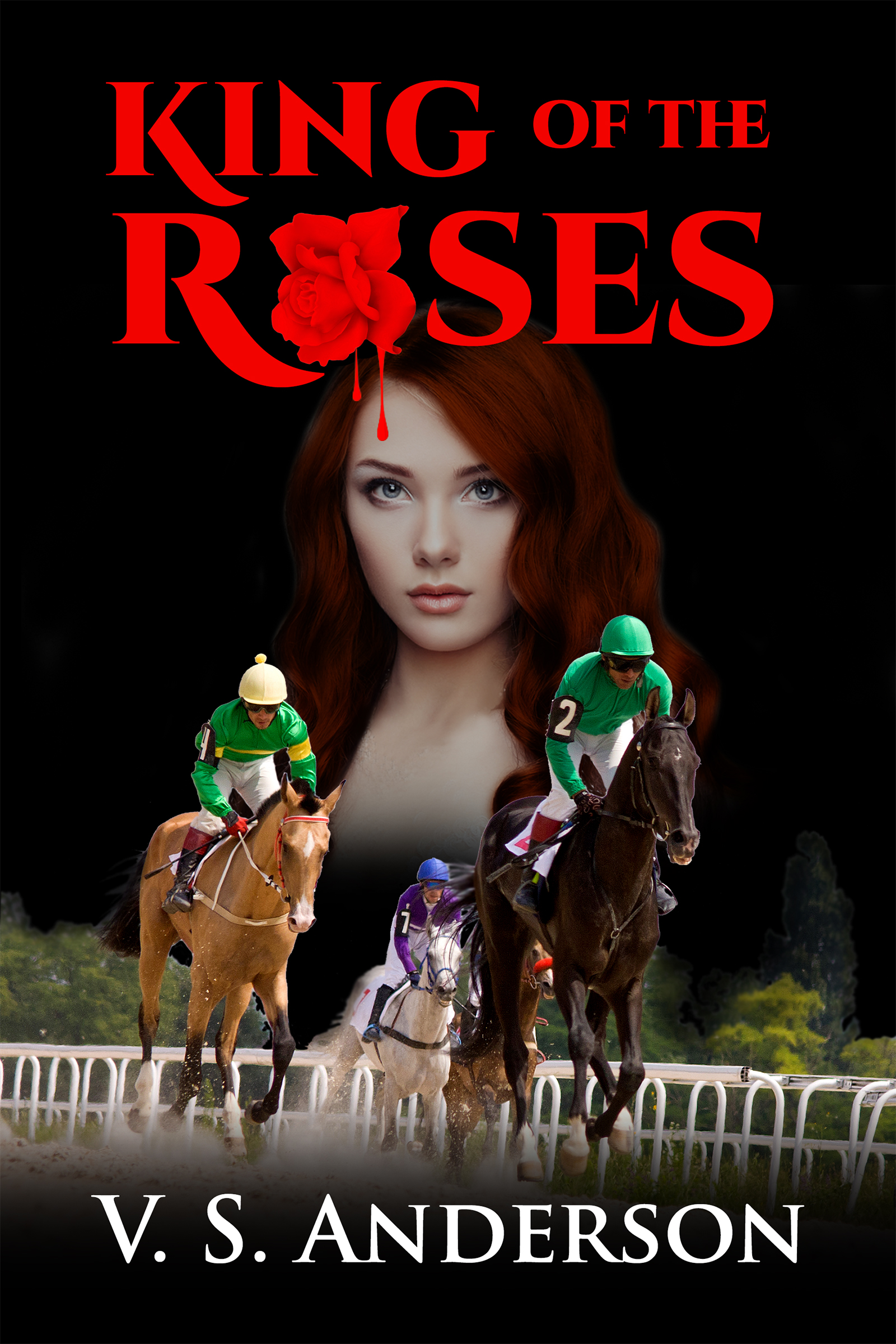
For a sense of what this exercise can contribute, here are a few lines from my novel King of the Roses and the corresponding lines structured as a screenplay.  Note that I converted the whole book, a choice that requires me to scrutinize every word because screenplays are radically length restricted (a 358-page book becomes a 100-page play). But casting individual scenes can provide some of the same benefits.
Set-up: A criminal who demands that Chris hold the Derby favorite finds Chris alone in a restaurant and escalates his threats. The criminal speaks the first line.
“I tried to get a hold of you last night. Why didn’t you answer the phone?”
“I was out.”
“No you weren’t. You just didn’t answer the phone. This isn’t a little romance we have here. This is business. What about it?”
Chris felt his spine crawl as if he were already dead, with demons dancing on his grave. The man stared at him steadily, tilting his head a little so that Chris could see his white, speckled scalp where his hair thinned on top.
“So when would I get paid?”
“You jocks is all the same. Money, money.”
“I haven’t seen any money.”
The man’s lower lip went on curling, but his eyes hardened. He stood up suddenly, clutching his overcoat to his paunch.
“I’ll tell you one thing I bet you have seen,” he said. “I bet you’ve seen what a jock looks like when he falls off in a race and gets his face stepped on. I bet you’ve seen that. Huh?”
BALDING MAN
I tried to get hold of you last night. Why didn’t you answer your phone?
CHRIS
I was out.
BALDING MAN
This isn’t a little romance we have here. This is business.
CHRIS
So when would I get paid?
BALDING MAN
You jocks is all the same. Money, money, money.
CHRIS
I haven’t seen any money.
The man stands, clutching his coat to his paunch.
BALDING MAN
I tell you one thing I bet you have seen. I bet you seen what a jock looks like when he falls off and gets his face stepped on. I bet you seen that, huh?
So what has this exercise done for me? Above all, it has forced me to look really hard at the inner reactions I’ve chosen to include in the prose-narrative format. Obviously they aren’t essential to meaning. I get to ask myself whether they add enough to justify the departure from action, from showing.
So the conversion allows me to see where my dialogue on its own takes readers. It also forces me to find the actions that express the characters’ reactions. I have to convert feelings into motion. Once discovered, these motions and actions can go back into my prose.
Again, you don’t have to go this spare. But you might make decisions about where to cut and where to add with more insight if you’ve tried the bare-bones telling that screenplays require.
You don’t need fancy software to do this. For the actual screenplay, I used Microsoft Word’s “styles” to create the various format patterns screenplays require. (The formatting didn’t translate directly into this blog post.) By the way, learning to use “styles” helps when you convert your Word document into the format for various e-publishing contexts. The important thing, however you structure your exercise, is to remember: no “feelings.” Just things viewers can see: action and dialogue.
Reblogged on WordPress.com
Source: This is how you get your book onto a bookstore shelf
Have you had success at getting your books into stores in the U.S.? My guess is that we can best count on independent booksellers–or is Barnes and Noble completely out of the question? In any case, I’m inspired to get going on POD versions of my books to find out. Let me hear about your experiences!
This good advice from Chris McMullen should start us all off right for 2016. Me, at least! Back to work tomorrow, after one more day of recovering from a holiday trip!
Filed under writing novels
This incredibly helpful piece came through The Story Reading Ape. All of us need to collect as much information as we can on how to make smart choices. A must read!
Filed under writing novels
Please check out my Works-in-Progress page and let me know your thoughts. Interested in swapping beta-reads? Contact me!
Filed under Publishing, Reviews, Virginia S. Anderson, Writing, writing novels
 As I’ve been reading around in the Indie-verse, I’ve found a couple of books I’ve decided not to finish. As both a writer and a reader, I’ve thought about what triggers me to abandon a book.
One feature that has stuck as a cause for my reaction can be summed up in advice Brian Klems of Writer’s Digest provided at the Writing Day Workshop I attended in Indianapolis in October:
Begin with conflict, not crisis.

In other words, writers I’m deciding sadly to give up on often begin with their characters in crisis. But Klems’s advice reminds me of a cruel but vital truth:
If I don’t know your character, I don’t care about her. If I don’t care about her, I honestly don’t care if she gets her brains blown out.
Sorry, but there it is.

When these writers begin their books, they have three Cs to deal with: Crisis, Character, and Conflict. It may sound counter-intuitive to state that, of the three, Crisis is the least important!
I know, I know: begin in medias res. But not when the folks in medias are just names on a page.
Can you pile on character, conflict, and crisis in opening scenes? I thought I’d try an experiment to find out.
Consider:
Sally found herself staring down the barrel of a gun. She stumbled backwards. He fired. The shot narrowly missed.
Crisis, big time. And a couple of what Paula Munier calls “micro-story questions,” the elements that help to deliver what she calls “narrative thrust.” Who’s shooting at her? Why? Will she escape the next shot?

Okay, I’d read on to the next bit. But if the following three pages consisted of her efforts to flee his escape, I’d be flipping ahead to see whether things got more interesting than an abstract flight-and-pursue.
What if, instead, you read:
Of course Mark was going to pull the trigger. When he threatened, he always delivered. Sally flung her hands up, stupidly, since they wouldn’t stop a bullet, and sprawled on her butt on the wedding dress jumbled on the tack room floor behind her. The gun went off in a brain-numbing explosion, the bullet slamming into the row of bridles hanging just above her head.

Take that, Mark, you scum!
We still get to the crisis pretty fast, but now we have many more micro-story questions. First, we’ve got conflict: these people have a history. It’s not just a question of why he’s shooting at her, but what between them has happened before to trigger her recognition that this isn’t a joke. “Why and who?” becomes “How does she know this about him? What has he done to make her think this now?” There’s a whole history of people in those queries.
More importantly, that wedding dress. Wedding dress? How in the world did a wedding dress get in the floor of that tackroom? And why a tackroom? We now know that these people somehow connect with horses, and that someone (Mark? Sally?) has just been through (or approached) a wedding. And he’s the determined sort who shoots first and asks questions later, while she’s (at present) a bit reactive and self-derogatory (calling herself “stupid”). Conflict and character as well as crisis—leading to a cornucopia of story questions! And all in the same number of sentences, four.
Some of my writing group colleagues are absolute minimalists and would opt for the first austere and abstract version. But to me, pure action is not nearly as engaging as action involving people I know or people I’ve been made deeply curious about.
An experiment like this leads to me be suggest that if you must demote one of the three Cs, let it be crisis! What? Start flat, with just characters in conflict? Well, yes.

As Stephen King argues, narrative tension arises not from wild, boisterous action but from people in “situations,” where they must react to each other and to the problems their situation presents.
True, you can’t spend pages on this development. It has to happen in that medias res moment, through careful pacing and selection of details.
As an illustration of how little we need a doomsday crisis, consider these opening lines from Suzanne Rindell’s The Other Typist:
They said the typewriter would unsex us.
One look at the device itself and you might understand how they—the self-appointed keepers of female virtue and morality, that is—might have reached such a conclusion. Your average typewriter, be it Underwood, Royal, Remington, or Corona, is a stern thing, full of gravity, its boxy angles coming straight to the point, with no trace of curvaceous tomfoolery or feminine whimsy. Add to that the sheer violence of its iron arms, thwacking away at the page with unforgiving force. Unforgiving. Yes; forgiving is not the typewriter’s duty.

We’ve got character, even though we haven’t met the speaker. We’ve got conflict: That nameless “they” is already on trial! I haven’t yet read this book Will I? If it lives up to this crisis-deprived opening, you bet.
If anyone is thinking about reviewing on Amazon, it might be a good idea to check out this discussion. I’ve recently posted reviews of books by people I’ve met on Goodreads. Will Amazon permit them? It looks as if we all need to be aware of these rules.
View original post 928 more words
Filed under writing novels


Paddy and his mom!


