Category Archives: writing novels

Amazon’s “Gray” Book Market Explained

Is Amazon's third-party-seller system robbing authors?

Is Amazon’s third-party-seller system robbing authors?

Today’s New York Times reports on the change in Amazon’s book-selling practices that allows third-party sellers to sell as “new” books they’ve acquired from remainder stocks or book reviewers as well as other sources. Authors won’t receive royalties on these sales, just as they would not from sales in used-book stores.

I’m posting this because I saw this issue flair up only briefly in a couple of the blogs I follow, and I thought it might be of interest to more writers.

The comments (at this writing there weren’t very many) challenge some of the assumptions and premises in the article. A recurring theme seemed to be that the publishing industry could do a better job of rewarding authors out front so that they were paid for their work regardless. Another is that as publishers buy into the print-on-demand trend, this form of supposed piracy will diminish.

There’s no discussion in the article of indie publishing. The focus is on hard-cover “new” books that would ordinarily provide royalties to the writers.

What about it? Is this a non-issue for you? Is it an issue only for writers aspiring to be traditionally published? I found myself wanting to comment that this article and Amazon’s policy is an argument for becoming one’s own publisher, in wh

ich case no book leaves “the store” unless the author has been paid for it. What do you think?

Leave a comment

Filed under Amazon pricing policy, business of writing, indie publishing, Marketing books, Money issues for writers, Print on Demand for fiction writers, Publishing, publishing contracts, Self-publishing, Writing, writing novels

Review: Every Writer Should Read Dorothy Sayers’s *Gaudy Night*

First Edition of Dorothy Sayers's Gaudy NightMaybe I should say, every female writer. The book I’m recommending is about women, yes. But was it written for women only? I’ll hold to the faith that my literary male friends might find some familiar sentiments in this story—timeless to my mind—of a woman struggling to balance romance and intellectual rigor with a successful writing career.

As a young woman scribbling away on various unworthy projects, I loved Dorothy Sayers’s whimsical accounts of the escapades of her patrician hero, Lord Peter Wimsey. At a time when the puzzle mysteries of Agatha Christie seemed to be the fashion, I much preferred the slower, character-driven, comedies of manners in Sayers’s accounts of aristocratic England between the wars.

Of course this world was completely exotic to me. A quintessential baby-boomer, I knew no English lords and thus tended to take her depiction as truth. I also knew little about Europe at that time, and skimmed over the occasional reference to world events, most of which were used more or less to demonstrate that Wimsey was not just a chatty dilettante but a behind-the-scenes actor on the veiled world stage. Social commentary in Sayers’s books gently speared the kinds of people who, forty years earlier, would have been the inhabitants of Downton Abbey.

Recently, though, looking for some relatively mindless pleasure while I recovered from surgery, I retrieved some old favorites for bedtime reading. I had always remembered Sayers’s earlier novel, The Nine Tailors, as haunting and original; I was surprised at how slowly it read on new acquaintance, how it relied on stereotypes (I’m now guessing) of inhabitants of the fen country. But I’d also remembered Gaudy Night as more lively—comic, actually—and decided to revisit it as well.

It is indeed lively, comic, sometimes even brutal in its depictions of British social types of the era. But it is more than social comedy. It is about an intelligent independent woman trying to decide whether such a woman can achieve love and marriage on her own terms, especially to a personality as overwhelming as Wimsey’s. It is about a woman exploring what it means to be an intellectual when combining “intellectual” and “woman” in the same breath was both oxymoronic and somehow unclean.

But above all—and hence this invitation to my colleagues—it is about writing. Harriet Vane, the protagonist, grapples not just with how to bring characters to life in the latest of her best-selling mystery novels, but also with writing as a vocation. As a way of touching the heavens, mentally and emotionally. In Gaudy Night, she writes both as a novelist and as a scholar, parsing the definitions of excellence in writing, of finding one’s voice in a fine, close piece of work that requires, and reflects, one’s best self. Watching these three themes—romance, intellectual rigor, and writing—converge is one of the pleasures of this book.

Harriet appears as foil to Wimsey in four of the Lord Peter novels; Gaudy Night is the third. The novel takes place in a fantasy world: Shrewsbury College, a woman’s college in Oxford at a time when there was no such thing! Female administrators, scholars, and students pursue deep, arcane questions just as their male counterparts did and do. But this devotion to academic excellence sets them up for attack from a world that is not ready for them.

Harriet returns to Shrewsbury for a “Gaudy,” which is sort of a homecoming/class reunion, and, seeking surcease from the emotional conflicts created by Lord Peter’s determination to marry her, finds herself drawn into the narrow-focused but fine-tuned academic life—and into a terrifying mystery as well. A “Poison Pen” berates, threatens, and ultimately injures the scholars as punishment for not recognizing a woman’s proper place in the world.

Yes, Harriet must partner with Lord Peter to solve the puzzle. But I suggest looking for a subtle comparison with the relationship we may, all of us, be so lucky as to experience with a superb editor whose fierce intelligence we combine with our own skills to produce something whole and deserving. And again, there’s that lovely convergence of themes: solving a difficult puzzle with high stakes, finding a way to love without surrendering oneself, and turning it all into a work of art.

These are themes that resonate for me. I don’t know a Lord Peter, so I don’t share that precise challenge. But here’s a Harriet I do know, returned to Shrewsbury to escape the publishing circus, and perhaps you know this person, too. This is from Chapter XI:

. . . In that melodious silence, something came back to her that had lain dumb and dead ever since the old innocent undergraduate days. The singing voice, stifled long ago by the pressure of the struggle for existence, and throttled into dumbness by that queer, unhappy contact with physical passion, began to stammer a few uncertain notes. Great golden phrases, rising from nothing and leading to nothing, swam up out of her dreaming mind like the huge, sluggish carp in the cool waters of Mercury. One day she climbed up Shotover and sat looking over the spires of the city, deep-down, fathom-drowned, striking from the round bowl of the river-basin, improbably remote and lovely as the towers of Tirnan-Og beneath the green sea-rollers. She held on her knee the looseleaf notebook that contained her notes upon the Shrewsbury scandal; but her heart was not in that sordid inquiry. A detached pentameter, echoing out of nowhere, was beating in her ears—seven marching feet—a pentameter and half:—

To that still center where the spinning world

Sleeps on its axis—

Had she made it or remembered it? It sounded familiar, but in her heart she knew certainly that it was her own, and seemed familiar only because it was inevitable and right.

To all our moments like this.

Leave a comment

Filed under inspiration for writers, Reviews, Writing, writing novels

Terrific Piece on Working with Critique Groups!

So many books!

This is one of the most thoughtful pieces I’ve read about the critique group process, from guest blogger Kathryn Craft posting at Writers in the Storm. It rings true for me on so many levels.

Are you in a critique group? Is Kathryn speaking to/for you?

Leave a comment

Filed under Editing your novel, Plot Development for writers, self editing for fiction writers, Writers' groups, Writing, Writing and Learning, writing novels

Great New Post from Chuck Wendig (a writer you want to meet if you haven’t)

KnowledgeI’m back from knee surgery and scanning my blogs. Not surprisingly, here’s a keeper. Chuck is a lively writer, so there may be some bad words. Well worth it. Here he tells us what I had to learn the hard way; that character, not plot, creates story. My favorite line from this piece–“Plot is the thing that characters poop.”


I learned this in My Failed Novel (here’s one of several posts on How Not to Write a Failed Novel, all of which I’m sure will help you become the Next Big Thing). I forced my characters to do something they most certainly did not want to do. The single good thing about that moment was that I had clearly created characters with lives of their own. I shoved them into action, and they rebelled, and a whole lot of important reviewers saw them rebelling. And said so in the highest venues. The End.

Sad Editing!

Chuck says “give your characters something to do.” I’d add that, if they have come to life, often what they do will not be what just anyone would do. It will often be a choice specific to them, to who they have become as you watched them and listened to them. Not all your readers will admire their choices. But those choices—motivated, yes, by who they are and the context, but at the same time personal, heartfelt, unique—will trigger the next cascade of actions that we think of as plot. So don’t settle for what the latest TV hero would have done. Set loose a character with the voice to tell you what SHE is going to do. Then get out of her way. Plot will be what ensues.

Book open to the stars

Leave a comment

Filed under Editing your novel, indie publishing, inspiration for writers, Learning to write, Myths and Truths for writers, Plot Development for writers, self editing for fiction writers, Self-publishing, What Not To Do in Writing Novels, Writing, writing novels

CONTEST! CONTEST! CONTEST!

Green River Writers Logo

Poetry and Prose Categories, Low Entry Fees, Cash Prizes! For information, email contest@greenriverwriters.org

GREEN RIVER WRITERS, here in my neck of the woods, has opened its annual contest.

Two grand prizes @ $175 for first place, 13 other categories all with cash prizes, $3 entries.

http://www.greenriverwriters.org

Green River Writers 2017 Contest Brochure


Leave a comment

Filed under Green River Writers, poetry, Writers' groups, Writing, writing contests, writing novels

Stupid Advice about Writing? Check This Out!

Figuring out if you're a writer: A drive into the dark!

Dodging the glare of negative advice!

Louie Cronin writes for Writer Unboxed: an inspirational tale for all of us who’ve wondered if we’re kidding ourselves about being writers. I especially love her list of things she recommends we deliberately ignore! Enjoy!

Leave a comment

Filed under inspiration for writers, Myths and Truths for writers, Writing, Writing and Learning, writing novels

Maybe You Don’t Need that Book on Writing After All . . .

Editing tips for writers. . . If you have a computer and can check out Editing 101 at Chris the Story Reading Ape’s blog. Susan Uttendorfsky of Adirondack Editing provides a host of FREE lessons on everything from “Removing Filter Words” (a must-read) to when to use “which” or “that.” I’ve found Susan’s posts to be accurate, clear, and friendly. Check them out!

4 Comments

Filed under correct grammar for writers of fiction, ebooks publishing and selling, Editing your novel, grammar rules for writers, indie publishing, Learning to write, Myths and Truths for writers, Plot Development for writers, self editing for fiction writers, Self-publishing, style for writers, Writing, writing novels

Help! Do I Really NEED an ISBN?

For book writers and lovers

As I was finishing up my posts on how to format your own Print-on-Demand book interior using InDesign, I reached the point where I found myself writing about copyright pages and ISBNs. I wrote confidently, “You must have an ISBN.” In a recent post, I recounted my own experience buying an ISBN for my paperback copy of King of the Roses and my upcoming publication of a POD version of Blood Lies.

But a query from a reader triggered research that suggested that my advice might be a little too simplistic. I found arguments that seemed to undercut that that screaming need for an ISBN.

Those posts inspired me to look a little more carefully into the question. In this post, I’ll explain what I’ve gathered from searching out a range of opinions.

My research suggests that if you were publishing only digitally, as of this writing, you WON’T need an ISBN, and, for reasons I’ll discuss below, shouldn’t accept a free one from Amazon or any other venue where you’ve uploaded your ebook.

But my Beginner’s Cheat Sheet series for formatting your book interior assumes you have already decided that, for your own reasons, you want a paperback, Print-on-Demand, version of your book.

So what seems to be the consensus on ISBNs and Print-on-Demand editions?

Nielsen ISBN Store UKAs a start, I learned that many countries, like Canada, provide free ISBNs and that authors in the U.K. go through a company called Nielsen. I’ve learned that ISBNs are considered international identifiers; the question isn’t about where an author writes, but rather, whether an author decides to participate in this national-identification system. In other words, the question of whether you need or want an ISBN doesn’t depend on which country you live in.

That said, all the evidence suggests that on the whole, if you’re publishing in paperback format, you will want to buy an ISBN.

BASICS: At Least It’s Hard to Get This Wrong

Wikipedia provides a useful definition of an ISBN, or “International Standard Book Number.” As the site says, if you are going to purchase ISBNs, each different edition of your book, except for reprints, MUST have a unique number. So if you have published an ebook and have an ISBN either because you’ve purchased one or because you accepted a free one from, say, Smashwords, you must acquire a new ISBN for your print edition.

Depending on the choices you make, your ISBN may be the single biggest expense you incur in the process of self-publishing if you edit and format your own book.

Wait! Why should an ISBN be an expense?  Can’t you get one for free?

Well, yes.

You can if you choose Option One:

  • You hire a book-publishing/packaging service that takes over some of the tasks of getting your book out into the market.
  • For a fee—usually several hundred dollars—the service will develop your cover and the necessary metadata—that is, the description of your book that will appear in catalogues.
  • You format your book according to the service’s guidelines and upload it.
  • The service may provide marketing. You will have a chance to accept a free ISBN.

Note that CreateSpace and Ingram, which I discuss below, are both basically book-packaging services, except that you pay either very little in the case of Ingram, or nothing, in the case of CreateSpace. You do all the work, and in CreateSpace, you can opt to receive a free ISBN.*

But whether you accept the ISBN that comes with your package from a paid publishing service or that CreateSpace or Smashwords supplies for free, there seems to be a catch. Maybe several catches:

Multiple sources tell me that free ISBNs belong to the publishing service—CreateSpace or Lulu or whichever one you choose—not you—and the publishing service—not you—becomes the “publisher.” So Amazon, the owner of CreateSpace, is the publisher of your CreateSpace book if you accept their ISBN.

This means:

  • You cannot take this ISBN to a new publisher or issue the book in your own imprint. If you want to publish elsewhere to take advantage of a wider range of distribution than Amazon provides, you will need a new ISBN—and there will be two or more different numbers for the same book, which can be confusing to your readers.
  • Amazon and other publishing services that produce indie books have limited distribution options. At Amazon you must pay extra for your book to show up in non-Amazon catalogues.
  • You may have limited control over the metadata of your book (the description that goes out to retailers, for example).
  • If Amazon is your publisher because you have accepted their free ISBN, you may find that any brick-and-mortar stores that might consider carrying your book will resist ordering from Amazon:
    • Amazon’s discount process disadvantages stores in comparison to other distributors.
    • Amazon does not allow returns.
    • Some booksellers are prejudiced against Amazon, believing that it has damaged their business.

To compound these problems, the quality of service you will receive at sites where an ISBN is included varies. CreateSpace does not market your book for you, and paid services may or may not provide reliable marketing. Paid services are often dinged for failing to fully reveal costs to the authors and for failing to fulfill contractual obligations. So choosing this option obligates you to do extensive due diligence. Explore services’ plans, read reviews, and check out the services’ reputations on watchdog sites like Preditors and Editors and Writer Beware. (Or course, such diligence is wise when dealing with any book packager whether or not you provide your own ISBN.)

Option One Twist: At one time, at Amazon, you could pay $10 so that your publishing name, or imprint, appeared as the publisher of your book. However, according to my research, Amazon no longer offers this option. Instead, you will pay $99 for a “Custom-Universal” ISBN. This expense allows you more distribution choices, but retailers will still see that your book is being distributed by Amazon, with all the problems that news may cause.

CreateSpace seems to require an ISBN “We print an ISBN barcode on the lower back right corner of every book we manufacture.”

To clarify for myself, I hunted around the CreateSpace site until I found Amazon’s own description of its handling of ISBNs and “imprints“—the name of the publisher that will appear in the metadata (your book’s “detail page”):
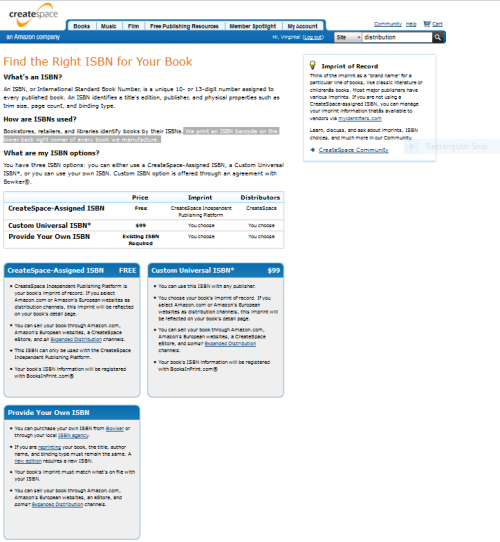
Amazon Distribution Options Screenshot

What’s not clear from these descriptions, to the amateur eye at least, is that when you choose Option Two, buying your own ISBN (below), you can publish anywhere you like and choose any distribution channel you like, which you cannot do if accept the free ISBN.

Moreover, if you choose Option Two, buying your own, you can buy it for about $25 as opposed to $99, though this process comes with its own catch.

Option Two:

You be the publisher.

You can do so by buying your own ISBN and either publishing exclusively with Ingram Spark or—and this seems to be the most recommended choice—publishing with BOTH Ingram Spark AND CreateSpace—again using your own ISBN.

My research suggests these advantages in publishing through Ingram, whether or not you also publish with CreateSpace:

  • Ingram has the widest distribution list. In fact, Amazon will distribute your book through Ingram if you publish with CreateSpace.
  • A book published through IngramSpark using your own ISBN will name you as the publisher and you will control your own metadata.
  • Publishing with both, buying your ISBN first, gives you the best of both worlds:
    • You’ll own and control your own book and data;
    • If bookstores do want to order your book they’ll be glad to do so through Ingram;
    • At the same time, you’ll also have the Amazon exposure that is most likely to result in sales.

Many if not most of the experts on self-publishing whose opinions I’ve monitored believe that these reasons alone justify paying for your own ISBN.

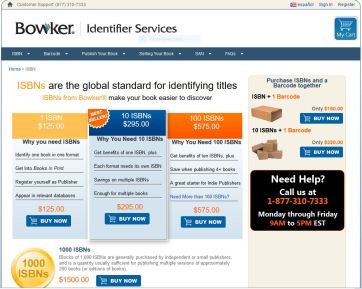
The catch to this option is that, yes, buying your own ISBN is relatively expensive. One will cost you (at this writing) $125. Most of the experts I’ve researched are clear that you’d be pound-foolish to buy just one. You can buy 10 for around $250, or $25 each.
Bowker buy ISBN now page

Yes, that’s still an outlay.

But purchasing ten ISBNs will cost you less, possibly much less, than paying a book-publishing/packaging service. And you can’t produce your book for free with your own name or imprint as publisher at CreateSpace unless you already have that ISBN in hand.

Is there a reason why you might NOT want to spend money on your own ISBNs? Here’s an informative article from ALLi, the Alliance of Independent Authors, on this topic. The site lists reasons to buy and not to buy. Briefly,

You will want an ISBN if

  • You harbor any dreams of ever selling your paperback in brick-and-mortar stores or, for that matter, selling through them. They rely on ISBNs for inventory and tracking.
  • You ever imagine your book showing up as an actual pick-up-and-read-me book on library shelves.
  • You want to publish at Ingram and take advantage of their superior distribution options.
  • You plan on publishing a lot of books, or making a career out of publishing your own or others’ books. If so, you’ll be playing in large, international markets, many of which rely on ISBNs, so that not having one will create confusion.

Here are a couple of more subjective reasons for wanting your own ISBNs.

  • An ISBN is a good way to point your friends and other potential buyers to all the different places where they can find your book.
  • Having ISBNs on your books makes you, and the books, look “professional.” When someone picks your book up in the store, it will “look” like the traditionally published books alongside.

You may not want an ISBN if

  • You plan on giving away your copies to family and friends.
  • You plan on doing all your own selling, say, at book fairs.
  • You don’t care if Amazon is the publisher of record of your book and their identifying number is the only number that will point to your book.

Bottom line:

Research carefully before deciding to opt out of the ISBN process or to accept a free ISBN. Make sure you know who will be the “publisher” of your book and what that means in terms of how it is handled and distributed. Be sure you won’t benefit from the international tracking services that having an ISBN provides. If you choose a book-packaging service other than Ingram or CreateSpace, make sure you fully understand the fee structure of what can turn out to be “vanity presses,” and make sure to compare these costs with those you’ll pay if you publish through Ingram and buy your own ISBN.

*Note that both Amazon and Ingram are offering new publishing services both for digital products and print versions of books. Discussion and evaluation of those ever-changing services is beyond the scope of this post, but I hope readers will chime in if they’ve had experiences with these services.

Please share your views and experiences! Have you published ebooks without ISBNs? Have you published Print-on-Demand books without them? Do you advise indie authors to buy or not to buy? Why or why not?
29 Comments

Filed under writing novels

Need Your Own ISBN? It’s Easy.

Of course, the first question is, do you need your own ISBN?

The long and short of it is—YES, YOU DO.

Here’s a site that provides a quick and dirty explanation of why indie authors should own their own ISBNs instead of letting Amazon or Book Baby or any of the other packagers give you one for “free.” As the site will make clear, there are hidden costs to this perk.

So if you’re convinced, as I was, how do you get an ISBN?

It’s really not hard at all.

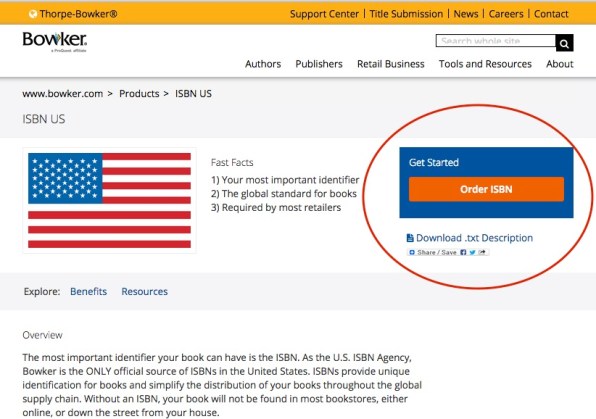
In the United States, ISBNs are sold through a company called Bowker. At http://www.bowker.com, you’ll find a link for “Authors.” On this page, you’ll be invited to click on various links promising help with your project, but for now, you’re interested in the link called “ISBN United States.”‘

Bowker

Next, you’ll click on a link to “Get Started: Order ISBN.”

Bowker Order ISBN page

On the next page, you’ll be able to scout the various plans and set up your “MyIdentifiers” account.

Bowker buy ISBN now page

At present, Bowker sells a single ISBN for $125, ten for $295 (they were on sale for $250 the day I wrote this), or 100 for $595. What should you do?

This is another personal choice. Experts online vary in their recommendations, but all seem to agree that most authors will need more than one ISBN. For example, if you buy just one at $125, use it for your ebook in the Kindle Store, then choose to create a POD edition needing its own ISBN, you’ve already spent $250—because each edition of your book requires its own ISBN. Most indie authors publish more than one book. Many publish more than ten books! How many books you expect to write will probably dictate the choice you make.

Note that the page offering you the ISBN options also offers you a chance to purchase a bar code. This code will eventually go on the cover of your POD book, providing the ISBN and the price you set for your book.

You can delay the bar-code purchase until you are actually ready to produce your cover. When you buy your ISBN(s) and create your Bowker MyIdentifiers account, you will find a link allowing you to purchase the appropriate bar code for that ISBN.

Bowker Manage ISBNs page

When you buy a bar code, your MyIdentifiers screen at Bowker will allow you to set the price that will appear on the bar code.

I chose to set this price to zero. Why? Because if you later want to change the price for any reason, you must produce a new cover with a new bar code. Uploading this new cover will cost you $25.

However, if your bar code reads “zero,” you can price the book any way you want, and other sellers can attach their bar codes over yours or charge whatever they want.

You will still set a retail price at Ingram for individual purchasers. Bookstores who might order your books to sell on their shelves get their discounts based on this price. At Ingram, you can edit both the price and discount over time if you like.

Bowker seems set up to accommodate even the most uneducated users. Like all technology, it requires you to follow a set of steps, but in the long run, negotiating these steps will give you the control you want over your work!

5 Comments

Filed under business of writing, indie publishing, Print on Demand for fiction writers, Publishing, Self-publishing, Writing, writing novels

Lies told by Small Presses

Some good warnings to take to heart!

I have a couple of things to add. Unless the market has changed drastically, having a good agent and getting an advance is unlikely to guarantee your book visibility or even entry into mainstream bookstores. I was paid $5000 by St. Martin’s in 1983; even though King of the Roses got superb reviews (check them out in the Amazon preview), the book never made it into any of the many stores, local or national, that existed at the time (before Amazon). I was told St. Martin’s would have had to commit to a massive advertising budget before any of the stores would find spine-out space for my book, let alone any kind of display or prominent position. (This despite the fact that my mother wrote many angry letters to bookstores demanding that they put my book on a stand in the doorway!) St. Martin’s did minimal advertising, but did make sure reviewers got copies and paid attention to them, which is a big deal, and something that will be hard for us to do for ourselves.

It’s my understanding (possibly erroneous?) that publishers’ budgets are even tighter today than they were in 1983. So true traditional publishing by one of the major houses doesn’t mean authors don’t still have work to do to get their books out there. But articles like this help us avoid pitfalls that will make our efforts go for naught!

Steven Capps's avatarBard & Books

Like many of my posts, this stems from something I saw in an online writer’s group. Essentially, someone who has been traditionally published from a small press was putting down people who self-publish. Personally, I have my own problems with self-publishing that I discuss in my “Why I’ll Never Self-Publish” post, but that is besides the point. At this point, I’d like to formally begin my rant against small presses.

In my opinion, traditional publishing is best done through an agent and then with a professionally recognized publisher. Small presses, unless they are recongized by writing organizations like Codex or SFWA, often give little more than what someone can do through self-publishing but will suck away 40-60% of the author’s share of royalties and then use self-publishing tools (like Createspace) to produce the book. Small Presses get away with this by telling authors lies in order to get them to sign…

View original post 1,144 more words

2 Comments

Filed under business of writing, indie publishing, King of the Roses, Marketing books, Money issues for writers, Myths and Truths for writers, Publishing, publishing contracts, Self-publishing, small presses, V. S. Anderson, Writing, writing novels, writing scams