Category Archives: Writing

A Lesson in First Pages!

A story hook is like strange headlights coming at you out of the dark on a lonely road. What lies ahead?

A story hook is like those headlights coming at you. What lies ahead?

I often get good posts from Writer Unboxed, and today’s example is a recurring feature of the site called “Flog a Pro.” Monthly contributor Ray Rhamey invites readers to vote the first page of a current bestseller up or down: would you turn the page?

I’m sharing the most recent candidate because it speaks with particular eloquence to an issue I’ve been encountering in the writing groups I haunt. Although I understand the reasons a few commenters voted no (e.g., snarky narrator, too much alliteration), I’d vote “yes” on this sample for one simple reason: it has a hook.

Wait! Doesn’t everybody know that the first page, or at least the first chapter, of a novel has to have a hook?

Apparently not.

Evidence that not everyone understands this basic principle of story-telling comes not just from recent writing-group conversations but also from a set of contest entries I recently judged. Novel after novel opened with “introductions” to plain-vanilla characters going about their daily business or mundane scene-setting, or, all too often, gobs of backstory about people I have no reason to care about.

A scintillating voice or a rapier sense of humor can carry me for a few such pages, but even then, by the end of the first chapter, I have to have someone to worry about, something really perplexing to wonder over, some hint of a serious conflict that will drive the book. Those are “hooks.”

When I ask, “But where is the story going? What is this character’s problem, goal, frustration?”, and of course, the generic but important, “Why should I care?”, the (often indignant) response will be

“Oh, that will come in Chapter Two.”

or

“The reader will see that develop over the course of the book.”

Um, the reader won’t see anything develop over the course of the book because she won’t read it. She won’t get to Chapter Two.

Books leading to a door in a brick wall

A hook points to the door in the wall. and says, “Come through!”

From occasional comments I’ve received, I think it’s possible that this defense arises because the writers in question are producing LITERATURE. People who read LITERATURE don’t need bombs going off on page one. They will patiently wait for a story to develop. They’ll slog through long, tedious details because they know that only simpletons require things to actually happen. Endless observations of people tying their shoelaces—portraying the cosmic meaning in such minutiae—that’s what LITERATURE is all about.

Excuse me. I read LITERATURE, too. And the LITERARY writers who get read know that story isn’t necessarily about bombs going off. In fact, it’s usually not the bombs that matter.It’s what they do to the people they blow up.

Story is built on heart-wracking conflict, on blistering emotion, on goals set and surrendered and recovered, on needs. STORY transcends genre.

And story begins on page one.


3 Comments

Filed under genres for writers, Learning to write, literary fiction, Myths and Truths for writers, Plot Development for writers, Writers' groups, Writing, writing novels

ALERT: Copyright Infringement by “Internet Archive.”

Do you have hard-copy books out, in or out of print? See this notice from Victoria Strauss of Writer Beware.

The Science Fiction and Fantasy Writers of America has issued an alert on copyright infringement by the Internet Archive. Other professional writers’ groups taking notice include the UK’s Society of Authors, which has posted an alert on its website, and the USA’s Authors Guild and National Writers Union, which have alerted their members.

Strauss posts the full notice from SFWA. What’s more, SFWA will generate a “takedown notice” for you that you can immediately email if your book is included on the offending site.

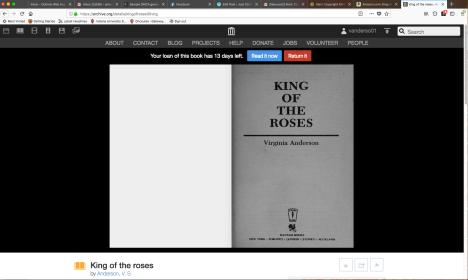
You can search the site easily to see if any of your titles are involved. I found that searching for a character’s name within the book text generated the best response.

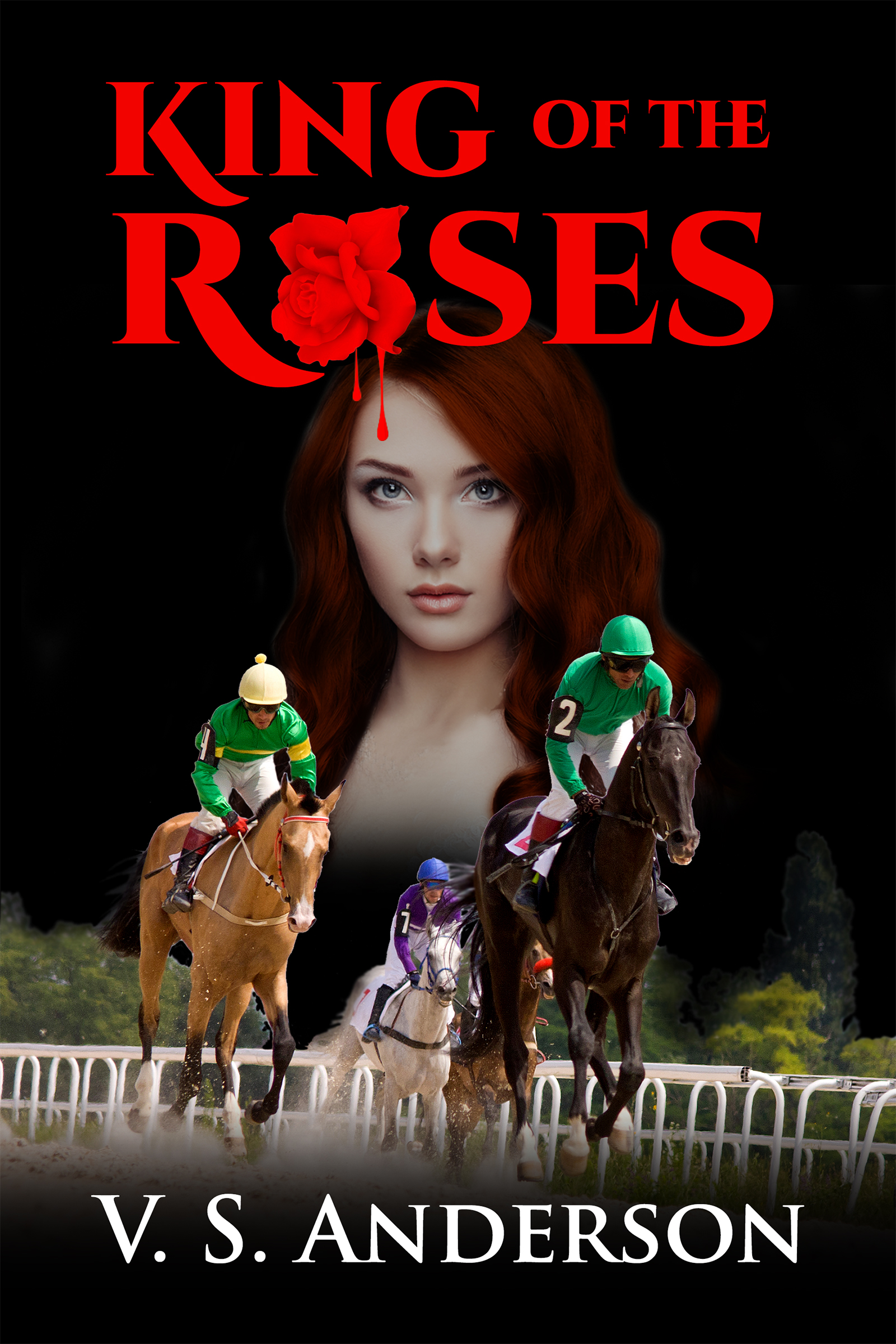
Illegal copy of King of the Roses on Internet Archive

Possibly you may not be concerned at having a pirated version of your book offered for free, but you may want to be informed that it exists.

I found the Bantam paperback edition of King of the Roses on the site. I’ve decided to send the takedown notice. Strauss says that two notices she sent have thus far not received responses.

Please pass this information on to anyone you think will benefit from it.


15 Comments

Filed under business of writing, Copyright for writers, King of the Roses, V. S. Anderson, Virginia S. Anderson, Writing

“Secret Writing Rules” and Why to Ignore Them…

A great post from Anne R. Allen via Chris the Story-Reading Ape. Thanks, Chris!

Actually, some of my *favorite* rules to ignore! Especially 1, 3, 5, 6–gee, all of them.

But I do have several cents worth of addenda from my own experience in writing groups and classrooms.

Number 1 is among my favorites because so many critiquers in my current online writing group just HATE “echoes” to the point that they are tone-deaf to the power of repetition for emphasis and rhythm. Anne’s examples beautifully illustrate this point.

And I love #3 because of the many times I’ve been scolded for using “passive voice” when in fact I was using a progressive tense, which requires “to be” as an auxiliary. I agree that progressive tenses can be overused, but there’s a big difference between “He ate when she came in” and “He was eating when she came in.” Again, check out Anne’s examples.

As for #5, I’ve often started to write a post on the consequences of cutting “all” adverbs. Idiocy. You could never use a “when” or “before” or “after” clause if you tried to do that. You could never use “often” or “never.” Okay, some adverbs don’t add any information. Cut them. But stay sane. I have discovered in myself a tendency to pile up adjectives, and I appreciate having that lapse pointed out. And I do believe in the power of strong verbs. But just the right adjective, in just the right place, can be magic.

As for the passive voice, the wonderful book Style: Ten Lessons in Clarity and Grace by the late Joe Williams (latest editions co-authored by Greg Colomb) has a terrific discussion of the uses and abuses of the passive voice—and actually clarifies what that critter is! Check it out.

As for point of view, in the comments Anne clarifies that she means using multiple points of view in different scenes, not in the same paragraph or even sentence, as I’ve seen writers do. I’ve become paranoically sensitive to accidental POV slips, almost to the point, I fear, of annoying some of my fellow critiquers. But I’ve been re-reading some Tony Hillerman, and he “head-hops” all the time. So what to do? Make a deliberate decision that head-hopping really serves your text. My guess is that the practice will interfere with the close identification you want to build between reader and character.

Also in the comments, Anne touches on the “that/which” option. In my view, these are clear-cut, with “that” opening an essential modifier and “which” a non-essential one. But as Joe Williams pointed out almost forty years ago in his classic essay, “The Phenomenology of Error,” even the most rabid promoters of the distinction ignore it all the time. So we can, too.

My bottom line (note cliché, rule #7): Writing is about making choices. Knowing why readers sometimes object to style choices helps you make good decisions. But sometimes those decisions are to ignore.


Chris The Story Reading Ape's avatarChris The Story Reading Ape's Blog

by Anne R. Allen

Somerset Maugham famously said, “There are three rules for writing. Unfortunately, nobody knows what they are.”

But pretty much everybody you meet in the publishing business will give you a list of them. (One is “never start a sentence with ‘there are’” —so watch yourself, Mr. Maugham.)

Some of the rules show up in any standard writing book or class, but others only seem to get circulated in critique groups, conference workshops, and forums.

They’re a secret to everybody else.

But you’ll run into them sooner or later. In a forum or workshop, somebody will tell you with schoolmarmish assurance that you MUST follow these secret writing rules to be a successful novelist.

Nobody knows exactly where these rules come from, or why so many great books have become classics without following a single one.

Don’t get me wrong: many “secret writing rules” involve useful tips…

View original post 88 more words

2 Comments

Filed under correct grammar for writers of fiction, Editing your novel, grammar rules for writers, Learning to write, Myths and Truths for writers, self editing for fiction writers, style for writers, Writers' groups, Writing

Ethics & the Literary Agent: What Rights Do Authors Have?

A must-read! Chris the Story Reading Ape posts guest interviews with agents that shed strong light on what an agent’s life is like and how authors can be better partners.

Chris The Story Reading Ape's avatarChris The Story Reading Ape's Blog

by Sangeeta Mehta  on Jane Friedman Site:

Today’s guest post is a literary agent Q&A by Sangeeta Mehta, a former acquiring editor of children’s books at Little, Brown and Simon & Schuster, who runs her own editorial services company.


By definition, literary agents are writers’ representatives. They work for writers, negotiating offers from publishers until their client deems them acceptable. But in today’s complex agent-author relationship, many writers feel that they aren’t in the position to negotiate with their agent, partly because they don’t understand the publishing landscape as well as their agent does, but also because they are wary of coming across as difficult or demanding.

Although it’s becoming more common for writers to change agents several times during the course of their careers, most would prefer to stay with one agent. But are writers really in the position to speak up if they feel that an agent isn’t honoring their obligations…

View original post 33 more words

Leave a comment

Filed under business of writing, Finding literary agents for writers, Interviews, Money issues for writers, Myths and Truths for writers, Publishing, Writing, writing novels

Important Advice on Agent Contracts from Victoria Strauss

Beware of literary agents who deal in "handshakes'Lucky enough to attract interest from an agent? Victoria Strauss, on her blog Writer Beware, keeps an eye on our business for us. Check out this short, important read on how NOT to set up your relationship with that friendly agent!

Leave a comment

Filed under business of writing, Finding literary agents for writers, Money issues for writers, Publishing, Writing, writing novels, writing scams

Reference Books and Style Guides, #amwriting

What an absolutely terrific post! I completely agree with Connie Jasperson about Strunk &White: too rigid, outdated (even though the general sentiment is fine). I have often recommended both Story and The Writer’s Journey to fellow writers–and I’ve promoted Rhetorical Grammar aggressively on this blog several times. This “textbook” provides a whole new way of looking at how readers read what you wrote. Invaluable! Thanks, Connie!

conniejjasperson's avatarLife in the Realm of Fantasy

I use the internet for researching many things on a daily basis. However, in my office, some reference books must be in their hardcopy forms, such as The Chicago Manual of Style. I (and most other editors) rely on the CMOS, as it’s the most comprehensive style guide, and is geared for writers of essays and novels, fiction, and nonfiction.

Strunk and White’s Elements of Style is an acceptable beginner style guide, but is presented in an arbitrary, arrogant fashion and sometimes runs contrary to commonly accepted practice. Strunk and White’s Elements of Style is still the same book it was when it was originally conceived, as it has not changed or evolved, despite the way our modern language has changed and evolved. Because the Elements of Style is somewhat antiquated in the rules it forces upon the writer, I no longer even own a copy of it.

Instead, I…

View original post 727 more words

2 Comments

Filed under Editing your novel, indie publishing, Learning to write, self editing for fiction writers, Self-publishing, style for writers, Writing, writing novels

Why I don’t use Beta Readers #WriterWednesday #AmWriting

Here’s a post that challenges received wisdom on beta readers from D. E. Haggerty. What do you think?

4 Comments

Filed under Editing your novel, looking for literary editors and publishers, Myths and Truths for writers, Plot Development for writers, Writers' groups, Writing, writing novels

Small Publishers – A Checklist #wwwblogs #amwriting

What would you add to this thoughtful post from Alison Williams Writing? Have your experiences with small publishers been good or bad? Are indie writers better off self-publishing? What do you think?

Leave a comment

Filed under business of writing, ebooks publishing and selling, Editing your novel, indie publishing, looking for literary editors and publishers, Marketing books, Money issues for writers, Myths and Truths for writers, Publishing, publishing contracts, Self-publishing, small presses, Working with literary editors, Writing, writing novels, writing scams

Against Outlines

Do you outline your novels? Why or why not?

Eye of digits

Since my title is “Against Outlines,” you may suspect I’m going to argue against them.

Maybe, though, I’m not vehemently against outlines for writing novels.

The outlines you need!

In my brief career as a romance novelist, outlines were essential.

After all, these books were short, about 55,000 words, and I had to produce them in a matter of months. Writing one had to be like running a mini-marathon.

Marathon runners

You were given a route and a clear finish line, and you had to run the same route as everybody else. You could throw in a leap or a flourish here and there—in fact, you were encouraged to, as long as you didn’t stumble off course or onto the sidewalk. No characters allowed to stop and drift into quirky shops or down unmarked alleys. Eyes on the prize!

Lest romance writers rightly take offense, let me be clear. Setting off on and finishing this course is no snap.

Free runners sport concept illustration

Planning at this level takes enormous discipline. Directing each scene so that each actor arrives at the mark for the scene to follow requires a well-honed sense of character motive and of how dialogue and action can deliver on that motive. And those flourishes: as I learned, to carve out a lane for yourself in the genre with all those thousands of others huffing along beside you, to be you without veering off course: that takes a brand of genius. Believe me, I was there. I know.

Outlines make such a demanding fictional endeavor doable. Each scene can be carefully slotted into the overall course. Too many talky scenes in a row? The outline will flog you back on pace. Three-quarters there? Do you have enough action to fill those last pages? The outline knows.

And of course, there’s that one thing we all need that outlines amply provide: a story arc. River in KentuckySomething’s going to change before the end of the story. You can’t write your final outline entry without knowing what that something is.

But. . .

“No surprise for the writer, no surprise for the reader.”

That’s what a dear late colleague of mine used to say. That “surprise for the writer” is what an outline trades away.

Writing without an outline is more like setting out on a road trip than a marathon. Whimsical road Depositphotos_17645691_s-2015

You do have a destination. You can see it, a glow on the horizon. But you’re not a hundred percent sure yet what’s giving off that glow.

So off you go. Maybe you have a map, but it offers you many forks, and you can’t even tell which one is shortest, let alone which one you’ll most enjoy. Along each fork you spot little side trips, where you park for a bit and wander to see what’s there. You find your characters in those quirky shops, down those murky alleys, picking up memories, fears, loves, trying them out like costumes to see what new selves they reveal.

You didn’t know your character loves French movies even though he doesn’t understand any French, or that she loves cats even though they make her sneeze. Or that she fell out of a tree and nearly died when she was ten, did you? Oh! That explains her anger at the father who didn’t catch her; now you discover her struggles with trust.

Without an outline, you don’t tell characters what to do. You follow them and discover what they do.

It’s not like you tag along blindly. If they get too wild, you may abandon them, leave them to their own stories . . . though you may come back one day just to see where they ended up.

Without an outline, there’s a sense in which the story writes itself.

haunting road Depositphotos_23990435_s-2015Dangerous? Oh, my lord, yes. It takes much longer. It tempts complication, which can be a storyteller’s bane.

But it can save you grief as well. My one great, sad lesson from my Failed Novel was that once you set your thinly known characters loose in the world, talking to each other and finding unexpected doors to open, they create themselves—excuse the cliché: they take on a life of their own. And once that starts to happen, you must listen. The marathon route says turn right here; they say, “No, we don’t like that direction.”

Boss characters you’ve found, not made, and they’ll punish you.

So maybe we need a middle ground. A road trip into delight and surprise for the writer-on-deadline who must get to that glow this week, not next year?

Magic book

What strategies do you use to keep your novel on track without giving up the chance for surprise?


Leave a comment

Filed under genres for writers, Myths and Truths for writers, Plot Development for writers, What Not To Do in Writing Novels, Writing, writing novels

More on Commas and Those Pesky Nonessential Modifiers!

Don Massenzio shares more on how to detect and punctuate essential and nonessential modifiers. This post from the Ediket blog provides some great practice examples! Check them out.

via How to Use an Appositive

1 Comment

Filed under correct grammar for writers of fiction, Editing your novel, grammar rules for writers, indie publishing, Learning to write, punctuation for writers of novels, self editing for fiction writers, Self-publishing, style for writers, Writing