Category Archives: Self-publishing

Need Your Own ISBN? It’s Easy.

Of course, the first question is, do you need your own ISBN?

The long and short of it is—YES, YOU DO.

Here’s a site that provides a quick and dirty explanation of why indie authors should own their own ISBNs instead of letting Amazon or Book Baby or any of the other packagers give you one for “free.” As the site will make clear, there are hidden costs to this perk.

So if you’re convinced, as I was, how do you get an ISBN?

It’s really not hard at all.

In the United States, ISBNs are sold through a company called Bowker. At http://www.bowker.com, you’ll find a link for “Authors.” On this page, you’ll be invited to click on various links promising help with your project, but for now, you’re interested in the link called “ISBN United States.”‘

Bowker

Next, you’ll click on a link to “Get Started: Order ISBN.”
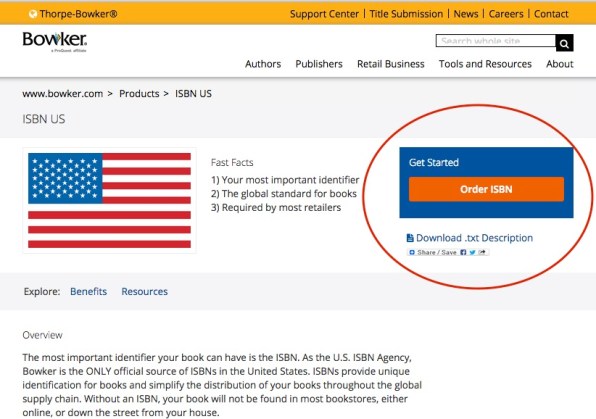
Bowker Order ISBN page

On the next page, you’ll be able to scout the various plans and set up your “MyIdentifiers” account.

Bowker buy ISBN now page

At present, Bowker sells a single ISBN for $125, ten for $295 (they were on sale for $250 the day I wrote this), or 100 for $595. What should you do?

This is another personal choice. Experts online vary in their recommendations, but all seem to agree that most authors will need more than one ISBN. For example, if you buy just one at $125, use it for your ebook in the Kindle Store, then choose to create a POD edition needing its own ISBN, you’ve already spent $250—because each edition of your book requires its own ISBN. Most indie authors publish more than one book. Many publish more than ten books! How many books you expect to write will probably dictate the choice you make.

Note that the page offering you the ISBN options also offers you a chance to purchase a bar code. This code will eventually go on the cover of your POD book, providing the ISBN and the price you set for your book.

You can delay the bar-code purchase until you are actually ready to produce your cover. When you buy your ISBN(s) and create your Bowker MyIdentifiers account, you will find a link allowing you to purchase the appropriate bar code for that ISBN.

Bowker Manage ISBNs page

When you buy a bar code, your MyIdentifiers screen at Bowker will allow you to set the price that will appear on the bar code.

I chose to set this price to zero. Why? Because if you later want to change the price for any reason, you must produce a new cover with a new bar code. Uploading this new cover will cost you $25.

However, if your bar code reads “zero,” you can price the book any way you want, and other sellers can attach their bar codes over yours or charge whatever they want.

You will still set a retail price at Ingram for individual purchasers. Bookstores who might order your books to sell on their shelves get their discounts based on this price. At Ingram, you can edit both the price and discount over time if you like.

Bowker seems set up to accommodate even the most uneducated users. Like all technology, it requires you to follow a set of steps, but in the long run, negotiating these steps will give you the control you want over your work!

5 Comments

Filed under business of writing, indie publishing, Print on Demand for fiction writers, Publishing, Self-publishing, Writing, writing novels

Lies told by Small Presses

Some good warnings to take to heart!

I have a couple of things to add. Unless the market has changed drastically, having a good agent and getting an advance is unlikely to guarantee your book visibility or even entry into mainstream bookstores. I was paid $5000 by St. Martin’s in 1983; even though King of the Roses got superb reviews (check them out in the Amazon preview), the book never made it into any of the many stores, local or national, that existed at the time (before Amazon). I was told St. Martin’s would have had to commit to a massive advertising budget before any of the stores would find spine-out space for my book, let alone any kind of display or prominent position. (This despite the fact that my mother wrote many angry letters to bookstores demanding that they put my book on a stand in the doorway!) St. Martin’s did minimal advertising, but did make sure reviewers got copies and paid attention to them, which is a big deal, and something that will be hard for us to do for ourselves.

It’s my understanding (possibly erroneous?) that publishers’ budgets are even tighter today than they were in 1983. So true traditional publishing by one of the major houses doesn’t mean authors don’t still have work to do to get their books out there. But articles like this help us avoid pitfalls that will make our efforts go for naught!

Steven Capps's avatarBard & Books

Like many of my posts, this stems from something I saw in an online writer’s group. Essentially, someone who has been traditionally published from a small press was putting down people who self-publish. Personally, I have my own problems with self-publishing that I discuss in my “Why I’ll Never Self-Publish” post, but that is besides the point. At this point, I’d like to formally begin my rant against small presses.

In my opinion, traditional publishing is best done through an agent and then with a professionally recognized publisher. Small presses, unless they are recongized by writing organizations like Codex or SFWA, often give little more than what someone can do through self-publishing but will suck away 40-60% of the author’s share of royalties and then use self-publishing tools (like Createspace) to produce the book. Small Presses get away with this by telling authors lies in order to get them to sign…

View original post 1,144 more words

2 Comments

Filed under business of writing, indie publishing, King of the Roses, Marketing books, Money issues for writers, Myths and Truths for writers, Publishing, publishing contracts, Self-publishing, small presses, V. S. Anderson, Writing, writing novels, writing scams

Creating a Universal Amazon Link – One Link Amazon Sites in all Countries

This is really important if you’re trying to run ad campaigns. It worked perfectly for me. Thanks to Don Massenzio for reposting his original advice.

Unknown's avatarDon Massenzio's Author Site

I posted this tip a while ago and got some positive feedback. If you set up buying links for your books, many of you are probably posting Amazon links for each country that you think your book will likely realize some sales.

There is no need to do this.

I was getting frustrated when I ran a free book promotion weekend and experimented with placing a Facebook ad that reached out to multiple countries. My dilemma with doing this is that I didn’t have a way to post all of the links for the various Amazon sites in other countries on my ad without it looking clumsy.

I searched for a way to create a universal link for my book. A universal link, when clicked by a potential reader, is designed to take them to my book on the appropriate Amazon page for their country.

All they needed to do was…

View original post 160 more words

Leave a comment

Filed under business of writing, ebooks publishing and selling, indie publishing, Marketing books, Print on Demand for fiction writers, Self-publishing, Tech tips for writers, Writing, writing novels

Do You Hate Semicolons? Prepare for Battle!

Do you hate semicolons when you read?This lively post by Aliette de Bodard at Chuck Wendig’s Terrible Minds blog not only defends semicolons but also encourages us to learn to use them well.  My take: I’m an enemy of rigid rules, period. That said, there are some conventions writers really need to know, such as how to punctuate dialogue so it’s clear when it begins and ends. Readers get used to some of these conventions, and get jerked out of the story when their expectations are not met.

So whether to break a rule can really be a judgment call. Definitely: you best serve your prose if you know the rule, and the consequences of breaking it.

And by the way, I’ve been reading an awful lot of wonderful books that are unself-consciously replete with adverbs. I think I’m going to go back to some of my stripped-down paragraphs and slip those adverbs back in. Judiciously, of course. And in the dark of night.

3 Comments

Filed under correct grammar for writers of fiction, Editing your novel, grammar rules for writers, indie publishing, Myths and Truths for writers, punctuation for writers of novels, self editing for fiction writers, Self-publishing, style for writers, Writing

Amazon Book Review Myths? Did You Hear These?

Some useful information about those pesky Amazon Review rulesStack of many books from Build Book Buzz. Share your own methods for getting reviews.

3 Comments

Filed under Amazon Kindle Direct Publishing, business of writing, ebooks publishing and selling, indie publishing, Marketing books, Myths and Truths for writers, Print on Demand for fiction writers, Reviews, Self-publishing, Writing, writing novels

Do you want to know just the right word?

Thanks, Jean! I’ve been using Thesaurus.com with excellent results—way better than that thin list on Word. But this tool looks even more useful. I’ll give it a try today and pass on my results.

Jean M. Cogdell's avatarJean's Writing

Happens to me more than I’d like to admit!

I’ve found a tool to help!

I’m on a roll, typing like a maniac. 

Until I stumble over a word.

My writing comes to a screeching halt. A word isn’t right. But I don’t want to stop my progress. After all, I’m a writing maniac. So I use a placeholder, I’ll come back to this section later and figure out the right word or words to convey my thoughts.

However, I’ve now got an itch I can’t scratch. That thought, that missing word or phase will not leave me alone.

Ever happen to you?

My protagonist whispers he can’t work like this, it’s too unprofessional.

Sigh, okay, I cave, save what little progress I’ve made and return to my placeholder. So I…

  • Think, think, think, I’ve got nothing.
  • Look up the placeholder word. Huh? Not even close. What was I thinking?
  • Check thesaurus. What…

View original post 261 more words

Leave a comment

Filed under ebooks publishing and selling, Editing your novel, indie publishing, Print on Demand for fiction writers, self editing for fiction writers, Self-publishing, style for writers, Tech tips for writers, Writing, writing novels

8 Tips For Formatting Your Book

These tips from Don Massenzio may help you make formatting decisions. I particularly like the idea of using 1.5 line spacing instead of single spacing in print books. Maybe I’ll try that next time!

pile of letters for writing

Check out my Beginner’s Cheat Sheet for formatting your hard copy book in InDesign!

Unknown's avatarDon Massenzio's Author Site

This blog post is designed to help fellow independently published authors improve the quality of their work, but most of the tips here apply to the formatting of any book. I’m speaking of the formatting of books for the consumption of readers, not formatting your manuscript to send off to an agent or publisher.  There are a whole other set of rules for that exercise.

I’ve put together a list of ten tips that you should consider when putting your book together. They are not in order of priority, but together, they can make your book stand out from the millions of others available through your favorite sales channel.

1. Put Some Thought Into Your Cover

I have to admit, this was something I didn’t waste a lot of time on when I published my first book, Frankly Speaking. I just went ahead and used the Kindle cover creator and cranked…

View original post 1,641 more words

2 Comments

February 20, 2017 · 4:43 pm

EDITING 101: 24 – Split Infinitives and Dangling Participles…

This column is near and dear to my heart. I’ve posted on dangling modifiers before, and I see them all the time in my critique groups.

A couple of thoughts:

First, the aversion to “splitting infinitives” comes from an 18th-century spurt of wishfulness that English could be elevated to the status of Latin—in which infinitives are one word and can’t be “split.” Note that in Romance languages like French and Spanish, this still holds true; how can you “split” an infinitive like “hablar”? But English is not a Romance language, despite having picked up many words from French, Spanish, and Italian, in particular. So those “rules” never rightly applied.

Second, note that “to boldly go” is in iambic pentameter, Shakespeare’s meter, and a natural meter in English. That’s why “to go boldly” just doesn’t have the same ring.

Dangling modifiers, on the other hand, cause problems for me because there’s a brief mental hiccup when the modifier has to hunt for its appropriate noun or pronoun. Sure, I can figure out who or what is doing the action of the modifier, but do writers really want readers stopping, even for a second, to puzzle?

This column is clear and concise, presenting these issues well. Thanks to both Chris the Story Reading Ape and Adirondack Editing.

Chris The Story Reading Ape's avatarChris The Story Reading Ape's Blog

Originally posted as the Dun Writin’—Now Whut? series on this blog, EDITING 101 is a weekly refresher series for some of you and brand new for others.

Courtesy of Adirondack Editing

Split Infinitives and Dangling Participles

Editors frequently correct both of these, but one is actually ok to use, while the other is not. Care to make a wager on which one is which before I get started?

Ante up!

What is a split infinitive, after all? It’s a sentence where a word, usually an adverb, interrupts a full verb (or full infinitive). A full infinitive is the verb with the word “to” in front of it—to run, to walk, to spit. The most famous split infinitive is “to boldly go.” Editors and teachers used to mark this as incorrect, but it’s all right to split an infinitive. Some examples are:

  • Lyn continued to quickly run toward the burning building.

  • Willow…

View original post 552 more words

3 Comments

Filed under correct grammar for writers of fiction, Editing your novel, grammar rules for writers, indie publishing, Learning to write, Myths and Truths for writers, self editing for fiction writers, Self-publishing, Writing

EDITING 101: 22 – Using Registered Trademarks and Brand Names…

Understanding how to handle trademarked or brand names does indeed seem to perplex many of us. There’s some good practical advice in this post.

Chris The Story Reading Ape's avatarChris The Story Reading Ape's Blog

Originally posted as the Dun Writin’—Now Whut? series on this blog, EDITING 101 is a weekly refresher series for some of you and brand new for others.

Courtesy of Adirondack Editing

Using Registered Trademarks and Brand Names

When you’re writing and your character uses a Kleenex, you’ve just used a registered trademark. Normally in non-fiction or business writing, you’d see it this way: Kleenex® or Kleenex™. To avoid using a brand name, you could say your character used a “tissue.”

You do not have to use ® or ™ in fiction writing.

The words aspirin, escalator, phillips-head screw, zipper, yo-yo, and vaseline were once trademarked but have lost that protection. They acquired such market dominance that the brand names became genericized. Companies want their products to become popular—but not too popular!—since there’s a price to pay for that popularity.

Kleenex®, Xerox®, Band-Aid®, and Plexiglas® were once in danger of losing their trademark…

View original post 402 more words

3 Comments

Filed under Copyright for writers, ebooks publishing and selling, Editing your novel, indie publishing, self editing for fiction writers, Self-publishing, Writing

7 Rookie Writing Mistakes (and 7 Ways to Improve)

The “7 Rookie Mistakes” from Phoebe Quinn over at A Writer’s Path ring true. For example, I agree we tend to recycle clichéd characters from other things we’ve read or TV we’ve seen. It’s because we do this that literature in all its forms has such a profound effect on our values. We think “heroes” MUST behave like the hero in a popular book or that people who behave like the villain we just saw on Netflix are also villainous. It’s tough in writing to catch yourself scribbling in these “types.”
What do you think of Quinn’s fixes? I’m still a pantser, and I do pay the price—but I want to be surprised by my own writing, and outlines take that surprise away.

theryanlanz's avatarRyan Lanz

pencil-7-writing

by Phoebe Quinn

7 rookie writing mistakes:

View original post 1,042 more words

1 Comment

Filed under ebooks publishing and selling, Editing your novel, genres for writers, indie publishing, Learning to write, Myths and Truths for writers, Plot Development for writers, self editing for fiction writers, Self-publishing, Writing, writing novels