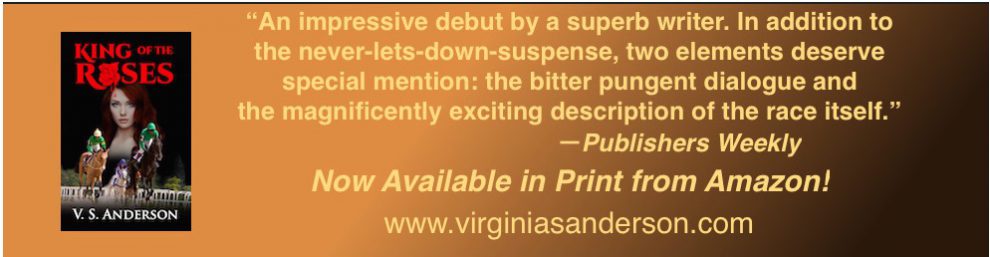
I found this really helpful! Thanks for Don Massenzio for passing it along.
Source: 12 book marketing buzzwords you need to know via Sandra Beckwith #h2e
I found this really helpful! Thanks for Don Massenzio for passing it along.
Source: 12 book marketing buzzwords you need to know via Sandra Beckwith #h2e

Is Amazon’s third-party-seller system robbing authors?
Today’s New York Times reports on the change in Amazon’s book-selling practices that allows third-party sellers to sell as “new” books they’ve acquired from remainder stocks or book reviewers as well as other sources. Authors won’t receive royalties on these sales, just as they would not from sales in used-book stores.
I’m posting this because I saw this issue flair up only briefly in a couple of the blogs I follow, and I thought it might be of interest to more writers.
The comments (at this writing there weren’t very many) challenge some of the assumptions and premises in the article. A recurring theme seemed to be that the publishing industry could do a better job of rewarding authors out front so that they were paid for their work regardless. Another is that as publishers buy into the print-on-demand trend, this form of supposed piracy will diminish.
There’s no discussion in the article of indie publishing. The focus is on hard-cover “new” books that would ordinarily provide royalties to the writers.
What about it? Is this a non-issue for you? Is it an issue only for writers aspiring to be traditionally published? I found myself wanting to comment that this article and Amazon’s policy is an argument for becoming one’s own publisher, in wh
ich case no book leaves “the store” unless the author has been paid for it. What do you think?
Source: Do you know how to publish an ebook with pictures?
 Here’s a post from last fall that I swiped from Jean’s Writing! Now that I’m about to epublish my “Beginner’s Cheat Sheet” on formatting your own Print-on-Demand book using InDesign, I’m going to need all the help I can get on formatting ebooks with graphics! What I like in Jean’s video is the idea that you can force text and image to stay together. Does anyone have any experience adding graphics to Kindle ebooks? Does this look like a good process to you? Any help will be WELCOME!
Of course, the first question is, do you need your own ISBN?
The long and short of it is—YES, YOU DO.
Here’s a site that provides a quick and dirty explanation of why indie authors should own their own ISBNs instead of letting Amazon or Book Baby or any of the other packagers give you one for “free.” As the site will make clear, there are hidden costs to this perk.
So if you’re convinced, as I was, how do you get an ISBN?
It’s really not hard at all.
In the United States, ISBNs are sold through a company called Bowker. At http://www.bowker.com, you’ll find a link for “Authors.” On this page, you’ll be invited to click on various links promising help with your project, but for now, you’re interested in the link called “ISBN United States.”‘

Next, you’ll click on a link to “Get Started: Order ISBN.”
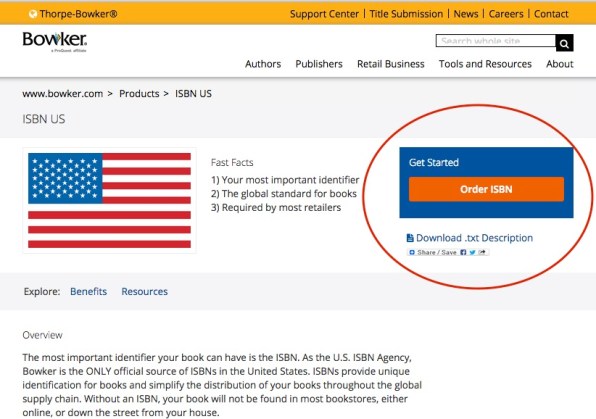
On the next page, you’ll be able to scout the various plans and set up your “MyIdentifiers” account.

At present, Bowker sells a single ISBN for $125, ten for $295 (they were on sale for $250 the day I wrote this), or 100 for $595. What should you do?
This is another personal choice. Experts online vary in their recommendations, but all seem to agree that most authors will need more than one ISBN. For example, if you buy just one at $125, use it for your ebook in the Kindle Store, then choose to create a POD edition needing its own ISBN, you’ve already spent $250—because each edition of your book requires its own ISBN. Most indie authors publish more than one book. Many publish more than ten books! How many books you expect to write will probably dictate the choice you make.
Note that the page offering you the ISBN options also offers you a chance to purchase a bar code. This code will eventually go on the cover of your POD book, providing the ISBN and the price you set for your book.
You can delay the bar-code purchase until you are actually ready to produce your cover. When you buy your ISBN(s) and create your Bowker MyIdentifiers account, you will find a link allowing you to purchase the appropriate bar code for that ISBN.

When you buy a bar code, your MyIdentifiers screen at Bowker will allow you to set the price that will appear on the bar code.
I chose to set this price to zero. Why? Because if you later want to change the price for any reason, you must produce a new cover with a new bar code. Uploading this new cover will cost you $25.
However, if your bar code reads “zero,” you can price the book any way you want, and other sellers can attach their bar codes over yours or charge whatever they want.
You will still set a retail price at Ingram for individual purchasers. Bookstores who might order your books to sell on their shelves get their discounts based on this price. At Ingram, you can edit both the price and discount over time if you like.
Bowker seems set up to accommodate even the most uneducated users. Like all technology, it requires you to follow a set of steps, but in the long run, negotiating these steps will give you the control you want over your work!
This is really important if you’re trying to run ad campaigns. It worked perfectly for me. Thanks to Don Massenzio for reposting his original advice.
I posted this tip a while ago and got some positive feedback. If you set up buying links for your books, many of you are probably posting Amazon links for each country that you think your book will likely realize some sales.
There is no need to do this.
I was getting frustrated when I ran a free book promotion weekend and experimented with placing a Facebook ad that reached out to multiple countries. My dilemma with doing this is that I didn’t have a way to post all of the links for the various Amazon sites in other countries on my ad without it looking clumsy.
I searched for a way to create a universal link for my book. A universal link, when clicked by a potential reader, is designed to take them to my book on the appropriate Amazon page for their country.
All they needed to do was…
View original post 160 more words
Some useful information about those pesky Amazon Review rules from Build Book Buzz. Share your own methods for getting reviews.
Thanks, Jean! I’ve been using Thesaurus.com with excellent results—way better than that thin list on Word. But this tool looks even more useful. I’ll give it a try today and pass on my results.
Happens to me more than I’d like to admit!
I’m on a roll, typing like a maniac. 
Until I stumble over a word.
My writing comes to a screeching halt. A word isn’t right. But I don’t want to stop my progress. After all, I’m a writing maniac. So I use a placeholder, I’ll come back to this section later and figure out the right word or words to convey my thoughts.
However, I’ve now got an itch I can’t scratch. That thought, that missing word or phase will not leave me alone.
Ever happen to you?
My protagonist whispers he can’t work like this, it’s too unprofessional.
Sigh, okay, I cave, save what little progress I’ve made and return to my placeholder. So I…

View original post 261 more words
These tips from Don Massenzio may help you make formatting decisions. I particularly like the idea of using 1.5 line spacing instead of single spacing in print books. Maybe I’ll try that next time!
Check out my Beginner’s Cheat Sheet for formatting your hard copy book in InDesign!
This blog post is designed to help fellow independently published authors improve the quality of their work, but most of the tips here apply to the formatting of any book. I’m speaking of the formatting of books for the consumption of readers, not formatting your manuscript to send off to an agent or publisher. There are a whole other set of rules for that exercise.
I’ve put together a list of ten tips that you should consider when putting your book together. They are not in order of priority, but together, they can make your book stand out from the millions of others available through your favorite sales channel.
1. Put Some Thought Into Your Cover
I have to admit, this was something I didn’t waste a lot of time on when I published my first book, Frankly Speaking. I just went ahead and used the Kindle cover creator and cranked…
View original post 1,641 more words
 Here’s a post about some of those mysterious tech skills that can confound non-tekkie verbal people like us writers. Check it out—whether you need to communicate with editors or with beta readers or if you just want to format your own book for Amazon or Smashwords. I can attest that you DO need Styles, and I’ve found GIMP, a free program recommended by this post, to work wonderfully as a graphics editor. You’ll need this information to format your hard-copy editions as well. Let me know what you think!
All you ever wanted to know about how to use Google resources! Thanks, Chris, for reblogging.
Have you used any of these? Which ones should we focus on?



Paddy and his mom!


 Just Can't Help Writing