Tag Archives: writing

Mea Culpa: Ableism and Handwritten Drafts

Mysterious park alleyShortly after my post on the joys and advantages of drafting by hand for writers, I began reading an article by Lauren E. Obermark in the November College English, a major journal for teachers of college writing. Obemark examines the environment of graduate studies in English through the lens of disability studies. Fortunately, you can read this article if you find it interesting; it’s available free at https://library.ncte.org/journals/ce/issues/v82-2

I read this article so that I could summarize it for my other blog, CollegeCompositionWeekly. I have not begun the summary yet, as this is a long, complex piece that will take me several passes to capture within my usual constraint of roughly 1000 words. But Obermark’s report on her survey of graduate students opened my eyes to a sin of omission in my cheerful post on handwritten drafts.

red yellow and orange flower fieldI wrote the post because, every time I draft, I appreciate how well drafting by hand works—for me. Obermark made me realize how easily even well-meaning positions can overlook the fact that the conditions I take for granted do not describe reality for everyone. That this caveat did not even occur to me opens my eyes to my own unquestioned assumptions about writing and literacy—to the limitations of my own definition of “literate practices.” Here are some of the really obvious realizations the article provoked:

  • Handwriting (and, for that matter, keyboarding) requires “sight-work” that, for many, may not be worth the effort or even doable.
  • Handwriting requires comfort holding a writing instrument, like a pen, and keyboarding requires comfort with the physical demands of typing.
  • Handwriting requires a steadiness in movement that not all of us may be graced with.

What have I missed? Many things, I’m sure.

men silhouette in the fog

I still would argue that for those who find handwriting and keyboarding comfortable, drafting by hand is a productive option worth experimenting with. But this article, and my belated grasp of how I fell so easily into that uninformed majority who think that what is normal for me is normal for all, have led me to wonder: writers need methods of drafting and converting their drafts to submittable texts. Which methods would writers who differ in their ableness from me recommend for capturing creativity and flexibility?

What do you use? Please share.


Leave a comment

Filed under Myths and Truths for writers, self editing for fiction writers

A Small Riff on Handwritten Drafts

Pen and notebook: The tools for writing by hand.

This morning I was reading an article for my other blog, College Composition Weekly, where I summarize selected articles from the scholarly journals on teaching writing (if you teach writing, check  out my archives). This sentence caught my eye:

In fact, [Maryanne] Wolf advocates that students write by hand, which “encourages them to explore their own thoughts at closer to a snail’s pace than a hare’s” . . . which can only help them think more deeply about the texts they both write and read.*

This claim resonates because I always compose my fiction and my own research articles in longhand and have advocated, including as a writing teacher, for this practice.

Why?

The simplest reason is that writing in longhand gives you an extra edit. Keyboarding makes you scrutinize all that text you have to transfer and, in my experience, encourages sharpening as well as re-evaluating structure. You’d be amazed at what you suddenly don’t need when you have to go to the trouble to type it all in.

But there are other reasons. I owe the next two points to an essay from the late 1970s, Janet Emig’s “Writing as a Mode of Learning.” I used to walk my students through an outline of this piece in an effort to persuade them of the value of writing not just to recall but to engage with their reading in all their classes. Two of Emig’s points are especially salient here:

  • Writing is a bodily activity. It doesn’t just happen in the mind.

Emig argues that humans learn better and make better connections when the body echoes what the mind is doing. That’s one reason you remember points better if you rehearse them aloud to yourself.

True, typing is also bodily, but handwriting magnifies the bodily engagement. I remember writing in high school with cartridge pens and just loving the process of shaping the black-ink letters on the white page. A written sentence was almost like a painting, merging visual, palpable, and mental into one.

  • Writing slows down thought; slower thought allows new connections and ideas to bubble up.

I’ve become deeply appreciative of my subconscious. Of how, even in the few instances when I’m white-hot and pouring out text, it’s in the middle of one sentence that the next few start to bloom, as do memories of how this sentence ties to sentences I wrote pages before. Typing can work this way, too, but the extra time to lay out the hand-shaped words allows more of that latent understanding to find its way into the light.

Other advantages of writing by hand

  • Margins! They’re repositories for all those adjunct thoughts that pop up, as well as for brainstorming word choices or for trailing revisions up the side and across the top with arrows showing the way. The Word comment function just doesn’t provide this same looseness, this same ability to explore all the relationships among ideas and sentences. I star things, circle things, even draw pictures. A handwritten page is a landscape, not a Lego tower.
  • A handwritten draft is a real draft! Its impermanence invites the scribbling that calls out inspiration. It never says, “There, finished,” which word-processed pages want to say even when we know they’re wrong.

Of course, my sense that handwriting is better is more a matter of my personal preference than a provable claim. I’m writing this on the screen, will edit it on the screen, as I do most of my blog posts. And these days, I risk not being able to decipher my handwriting if I wait too long to come back.

All the same, if I get stuck when I’m writing, I pick up the pen and the notebook and head for a comfortable chair to recover the slow, free sense of living words that writing in longhand offers. The words just loosen up there.

*Smith, Cheryl Hogue. “”Fractured Reading: Experiencing Students’ Thinking Habits.” Teaching English in the Two-Year College 47/1 (2019): 22-35.


2 Comments

Filed under Editing your novel, indie publishing, inspiration for writers, self editing for fiction writers, Self-publishing, writing novels

Is A Split Infinitive Still A Grammar Mistake In Writing? – by Derek Haines…

Hear, hear. One of the silliest rules people pass around. I particularly like the way Derek’s examples show how moving the adverb around changes meaning.

I’d add two points. One, “to boldly go” sounds so right because it’s iambic pentameter, one of the most natural rhythms for spoken English (Shakespeare’s meter).

Second, many “rules” like this evolved because 17th- and 18th-century pedants wanted to “improve” English by making it behave like Latin–ignoring the fact that English falls into an entirely different class of language than Latin. But hey, if Latin (one-word) infinitives can’t be split, we shouldn’t split English infinitives, either, even if they are two words.

Thanks to the Story Reading Ape for sharing this useful post!

Chris The Story Reading Ape's avatarChris The Story Reading Ape's Blog

on Just Publishing Advice:

Almost every style guide will tell you should avoid the split infinitive.

But is this generalised rule always valid?

We all know the famous Star Trek example of breaking the rule: to boldly go where no man has gone before.

It would sound awkward if I applied good English grammar. My grammar checker correction says it should read: to go where no man has gone before boldly.

Continue reading HERE

View original post

2 Comments

Filed under correct grammar for writers of fiction, Editing your novel, grammar rules for writers, Myths and Truths for writers, self editing for fiction writers, Self-publishing, style for writers

How to use quote marks in fiction writing – by Louise Harnby…

I’d saved this post from earlier and have just checked in. Harnby has a wonderful way of explaining clearly, with good examples. Not only did she note a problem I see often (U.S. writers thinking that “distanced” words should be in single quotes), but she also told me something I didn’t know, and I’m a grammar geek: that U.K. editing places quote marks inside the punctuation in nested quotes. I’d seen that practice but hadn’t made the leap to generalizing to the rule. Use this guide whenever you wonder what to do with those annoying ” and ‘ marks.

Chris The Story Reading Ape's avatarChris The Story Reading Ape's Blog

Here’s how to use quote marks (or speech marks) according to publishing convention in your fiction writing. The guidance covers both US English and UK English conventions.

In this post, I cover the following:

  • What quote marks are used for
  • Omitting a closing quote mark in dialogue
  • Whether to use single or double quote marks
  • Whether to use straight or curly quote marks
  • Where the closing quote mark goes in relation to other punctuation​
  • When not to use quote marks​

Continue reading HERE

View original post

Leave a comment

Filed under correct grammar for writers of fiction, Editing your novel, grammar rules for writers, punctuation for writers of novels, self editing for fiction writers, Self-publishing

Dealing with ‘seemed’ and other tentative language in fiction – by Louise Harnby…

This column from Louise Harnby, via Chris the Story Reading Ape, tackles the recurring problem of how to convey information about multiple characters in a scene without breaking point of view. It’s certainly a problem I struggle with. These are good reminders that there are better ways than “seemed” or “appeared to” to get across what that non-pov character might be up to. Check it out!

Chris The Story Reading Ape's avatarChris The Story Reading Ape's Blog

If your characters seem or appear to be doing or feeling something – probably, maybe, perhaps – then you might be using half measures to express a good chunk of that action or emotion.

Uncertainty can drag a story down.

Here’s how to edit for it at line level.

Continue reading HERE

View original post

2 Comments

Filed under Editing your novel, indie publishing, self editing for fiction writers, Self-publishing, style for writers

The Pros and Cons of Prologues

Thanks to Chris the Story Reading Ape for making this visible! I’m of the “do what serves the story school,” and I hate hard-and-fast rules (“Agents hate prologues”). What about you? Weigh in!

M.L. Davis's avatarM.L. Davis Writer

Prologues can be a contentious issue. Everybody has a different opinion on them. I’ve known of readers who love them, agents who hate them, and everything in between! The last novel I wrote started with a prologue, even though as a reader I’m not a huge fan of them. Sometimes you just have to do what works for your novel. But for anyone who’s not sure, I’ve listed some of the pros and cons of prologues below.

The Pros:

You can hook the reader
Prologues tend to be short and sweet, and so it gives you the opportunity to really hook the reader with a gritty opening. You don’t need to introduce the characters involved in any depth, which gives you the chance to create a real air of mystery.

Chance to use a different POV
The prologue doesn’t have to follow the pattern of the rest of your story…

View original post 492 more words

Leave a comment

Filed under Myths and Truths for writers, Plot Development for writers, writing novels

3 Critical Things You Won’t Learn in an MFA Program – by Susan DeFreitas…

Everyone should read this! I’ve learned from attending conferences that agents and editors read differently from writing-group colleagues. Until you’re critiqued by an actual agent, you can’t know what works for them in your opening pages. You won’t get that feedback from cold querying, but conferences provide opportunities to learn firsthand how what you’ve written is received.

DeFreitas provides a link as well to a good series on first novel pages. Dig in!

Chris The Story Reading Ape's avatarChris The Story Reading Ape's Blog

on Jane Friedman site:

The pros and cons of an MFA (Master of Fine Arts) in creative writing are widely debated: on one hand, such programs offer students the opportunity to work with accomplished authors, whose expertise (and endorsements) could make all the difference in publishing their first book. On the other hand, such programs often come with a hefty price tag, with fully funded options few and far between.

But regardless of whether you go for an MFA, some things are critical to establishing a career as an author that you probably don’t know, unless you’ve learned them the hard way (or you’ve worked in publishing).

I say this as someone who went for an MFA and then went on to establish a career as both an author and an editor. And this is information I want to circulate widely—first, because I know how hard it is to have…

View original post 77 more words

Leave a comment

Filed under Editing your novel, Finding literary agents for writers, Plot Development for writers, Writers' conferences, writing novels

FREE Download! What You WILL Miss When You Proofread!

It’s a plain truth that our eyes skip over typos when we’re proofreading our own work. Words you left out or accidentally cut (or accidentally failed to cut) may be the hardest mistakes to catch. But the good news is that you CAN catch another type of invisible errors: punctuation and spacing glitches that detract from the professional manuscript you want to market under your name.

In this pdf, What You WILL Miss When You Proofread, I’ve combined three blog posts to show you some simple tricks using an old friend, Find/Replace, to search for and fix common typos from double periods to missing quotes. You won’t need any elaborate codes; all the commands you need are right there in the FIND box.

My fixes are based on Word, but you should be able to adapt them to any word-processing program you use.

Download!

An image for What You WILL Miss When You Proofread

3 Comments

Filed under Amazon Kindle Direct Publishing, book design for creative writers, Editing your novel, indie publishing, Print on Demand for fiction writers, punctuation for writers of novels, self editing for fiction writers, Self-publishing, Tech tips for writers

Writing Software: Why you need Microsoft Word – by Lisa Poisso…

And now a completely different opinion on whether you can or should replace Word. I’m not the best judge here because my old Word still works fine for me. The phrase “industry standard” does carry some weight; again, it may come down to the question of how many obstacles you want to put between yourself and your prospective agent or editor. What do you think?

Chris The Story Reading Ape's avatarChris The Story Reading Ape's Blog

When your book is ready for editing, it’s time to pack it neatly into an industry-standard file format. Whether you write in dedicated writing software like Scrivener or key your story into Google Docs after writing it longhand, a finished novel isn’t a private creative endeavor or hobby anymore. Now it’s a product for an industry with professional standards and technical requirements.

If your manuscript is destined for a literary agent, freelance editor, formatter, designer, publisher, or other professional, the standard format is Microsoft Word.

Continue reading HERE

View original post

Leave a comment

Filed under Editing your novel, indie publishing, Publishing, self editing for fiction writers, Tech tips for writers, Working with literary editors

10 Totally Free Microsoft Word Alternatives For Writers – by Derek Haines…

For years, I’ve used a 2008 version of Word that came with the computer before this one. I’ve successfully uploaded to Smashwords, Ingram, and Amazon using that ancient system. At the same time, my curiosity is whetted. Have you tried any of these programs? Do they work better than Word, and if so, how?

Chris The Story Reading Ape's avatarChris The Story Reading Ape's Blog

on Just Publishing Advice:

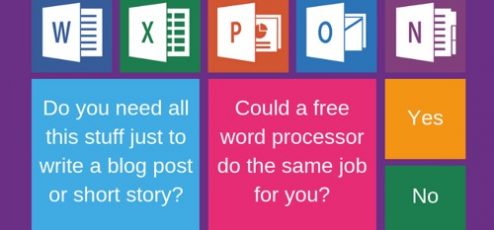
Do you really need all those Microsoft Office programs just to write?
Writers write words. Are you a writer?

I’m sure you don’t prepare business plans with charts and graphs. You don’t use online collaboration tools. You don’t schedule meetings for a group of directors.

I doubt if you would ever need to create business presentations with 100 slides.

You write your words down for blog posts, content articles, guest posts, short stories and maybe poems. So why do you pay for MS Office to do these simple writing tasks?

There is no need to pay for a word processor

Continue reading HERE

View original post

Leave a comment

Filed under indie publishing, Print on Demand for fiction writers, Self-publishing, Tech tips for writers