Tag Archives: publishing

Do you know how to publish an ebook with pictures?

Source: Do you know how to publish an ebook with pictures?

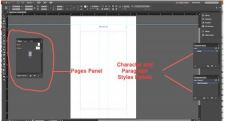
Workspace in InDesignHere’s a post from last fall that I swiped from Jean’s Writing! Now that I’m about to epublish my “Beginner’s Cheat Sheet” on formatting your own Print-on-Demand book using InDesign, I’m going to need all the help I can get on formatting ebooks with graphics! What I like in Jean’s video is the idea that you can force text and image to stay together. Does anyone have any experience adding graphics to Kindle ebooks? Does this look like a good process to you? Any help will be WELCOME!


4 Comments

Filed under Amazon Kindle Direct Publishing, book design for creative writers, business of writing, ebooks publishing and selling, indie publishing, Print on Demand for fiction writers, Self-publishing, Tech tips for writers, Writing

Need Your Own ISBN? It’s Easy.

Of course, the first question is, do you need your own ISBN?

The long and short of it is—YES, YOU DO.

Here’s a site that provides a quick and dirty explanation of why indie authors should own their own ISBNs instead of letting Amazon or Book Baby or any of the other packagers give you one for “free.” As the site will make clear, there are hidden costs to this perk.

So if you’re convinced, as I was, how do you get an ISBN?

It’s really not hard at all.

In the United States, ISBNs are sold through a company called Bowker. At http://www.bowker.com, you’ll find a link for “Authors.” On this page, you’ll be invited to click on various links promising help with your project, but for now, you’re interested in the link called “ISBN United States.”‘

Bowker

Next, you’ll click on a link to “Get Started: Order ISBN.”
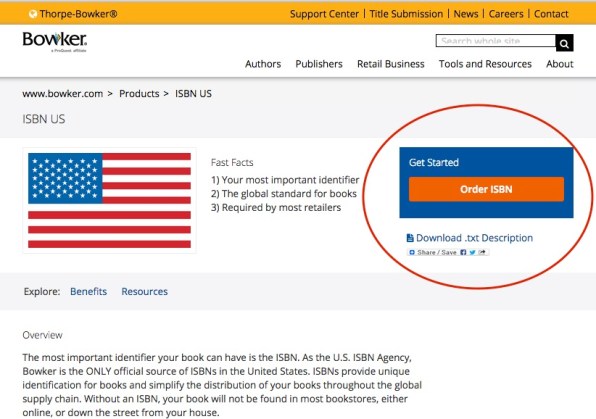
Bowker Order ISBN page

On the next page, you’ll be able to scout the various plans and set up your “MyIdentifiers” account.

Bowker buy ISBN now page

At present, Bowker sells a single ISBN for $125, ten for $295 (they were on sale for $250 the day I wrote this), or 100 for $595. What should you do?

This is another personal choice. Experts online vary in their recommendations, but all seem to agree that most authors will need more than one ISBN. For example, if you buy just one at $125, use it for your ebook in the Kindle Store, then choose to create a POD edition needing its own ISBN, you’ve already spent $250—because each edition of your book requires its own ISBN. Most indie authors publish more than one book. Many publish more than ten books! How many books you expect to write will probably dictate the choice you make.

Note that the page offering you the ISBN options also offers you a chance to purchase a bar code. This code will eventually go on the cover of your POD book, providing the ISBN and the price you set for your book.

You can delay the bar-code purchase until you are actually ready to produce your cover. When you buy your ISBN(s) and create your Bowker MyIdentifiers account, you will find a link allowing you to purchase the appropriate bar code for that ISBN.

Bowker Manage ISBNs page

When you buy a bar code, your MyIdentifiers screen at Bowker will allow you to set the price that will appear on the bar code.

I chose to set this price to zero. Why? Because if you later want to change the price for any reason, you must produce a new cover with a new bar code. Uploading this new cover will cost you $25.

However, if your bar code reads “zero,” you can price the book any way you want, and other sellers can attach their bar codes over yours or charge whatever they want.

You will still set a retail price at Ingram for individual purchasers. Bookstores who might order your books to sell on their shelves get their discounts based on this price. At Ingram, you can edit both the price and discount over time if you like.

Bowker seems set up to accommodate even the most uneducated users. Like all technology, it requires you to follow a set of steps, but in the long run, negotiating these steps will give you the control you want over your work!
5 Comments

Filed under business of writing, indie publishing, Print on Demand for fiction writers, Publishing, Self-publishing, Writing, writing novels

Lies told by Small Presses

Some good warnings to take to heart!

I have a couple of things to add. Unless the market has changed drastically, having a good agent and getting an advance is unlikely to guarantee your book visibility or even entry into mainstream bookstores. I was paid $5000 by St. Martin’s in 1983; even though King of the Roses got superb reviews (check them out in the Amazon preview), the book never made it into any of the many stores, local or national, that existed at the time (before Amazon). I was told St. Martin’s would have had to commit to a massive advertising budget before any of the stores would find spine-out space for my book, let alone any kind of display or prominent position. (This despite the fact that my mother wrote many angry letters to bookstores demanding that they put my book on a stand in the doorway!) St. Martin’s did minimal advertising, but did make sure reviewers got copies and paid attention to them, which is a big deal, and something that will be hard for us to do for ourselves.

It’s my understanding (possibly erroneous?) that publishers’ budgets are even tighter today than they were in 1983. So true traditional publishing by one of the major houses doesn’t mean authors don’t still have work to do to get their books out there. But articles like this help us avoid pitfalls that will make our efforts go for naught!

Steven Capps's avatarBard & Books

Like many of my posts, this stems from something I saw in an online writer’s group. Essentially, someone who has been traditionally published from a small press was putting down people who self-publish. Personally, I have my own problems with self-publishing that I discuss in my “Why I’ll Never Self-Publish” post, but that is besides the point. At this point, I’d like to formally begin my rant against small presses.

In my opinion, traditional publishing is best done through an agent and then with a professionally recognized publisher. Small presses, unless they are recongized by writing organizations like Codex or SFWA, often give little more than what someone can do through self-publishing but will suck away 40-60% of the author’s share of royalties and then use self-publishing tools (like Createspace) to produce the book. Small Presses get away with this by telling authors lies in order to get them to sign…

View original post 1,144 more words

2 Comments

Filed under business of writing, indie publishing, King of the Roses, Marketing books, Money issues for writers, Myths and Truths for writers, Publishing, publishing contracts, Self-publishing, small presses, V. S. Anderson, Writing, writing novels, writing scams

A Fun Post on Rejection (No Kidding)

rejection made funny!Here’s another good one from over at Writer Unboxed: Louie Cronin, Cronin the Barbarian of Car Talk fame, explains why she became an expert in rejecting submissions—and what her experience means for writers. If you are a Car Talk fan, you’ll get an extra kick out of this! Have  you ever thought of rejection this way?

1 Comment

Filed under business of writing, Finding literary agents for writers, looking for literary editors and publishers, Marketing books, Myths and Truths for writers, Publishing, Writing, writing novels

6 Basic Tech Skills for Writers

Tech skills for writersHere’s a post about some of those mysterious tech skills that can confound non-tekkie verbal people like us writers. Check it out—whether you need to communicate with editors or with beta readers or if you just want to format your own book for Amazon or Smashwords. I can attest that you DO need Styles, and I’ve found GIMP, a free program recommended by this post, to work wonderfully as a graphics editor. You’ll need this information to format your hard-copy editions as well. Let me know what you think!

1 Comment

Filed under Amazon Kindle Direct Publishing, ebooks publishing and selling, indie publishing, Print on Demand for fiction writers, Publishing, self editing for fiction writers, Self-publishing, Smashwords, Tech tips for writers, Working with literary editors, Writing, writing novels

A Book Production Checklist for Indie Authors

A comprehensive list for producing your own book for ingram, CreateSpace, KDP, and others! Lots of links and resources. Thanks, Chris!

Chris The Story Reading Ape's avatarChris The Story Reading Ape's Blog

An extract by Carla King, on BookWorks Site:

img_7935

Are you ready to upload your book for sale to the online retailers?

Got all your front and back matter, images, fonts, and ISBNs?

Use this checklist to make sure you’ve done everything you can to create a quality book that competes with books produced in the traditional publishing houses.

But first, here’s a quick overview of the entire book production process.

It begins with an unedited manuscript and ends with a check of the final proof before distribution.

Continue learning at the following link:

Book Production Checklist

View original post

Leave a comment

Filed under Amazon Kindle Direct Publishing, book design for creative writers, business of writing, ebooks publishing and selling, indie publishing, Print on Demand for fiction writers, Publishing, Self-publishing, Tech tips for writers, Writing, writing novels

Do you know how to publish an ebook with pictures?

Here’s some simple advice that may prove useful even if you’re not working on a children’s picture book! Jean Cogdell tries things out for us and shares!

Jean M. Cogdell's avatarJean's Writing

Using MS-Word?

Success at last! When I loaded it up to KDP, everything worked!i-did-it

If you write children’s books or comic books, I’m sure you’ve heard of Kindle Kids’ Book Creator. This program is terrific. However, the program limits which electronic devices that can open and read the book.

I wanted my picture books to be available on e-readers and tablets. I found out after using KKBC for A Most Reluctant Princess; this wasn’t possible. Using KKBC limits which electronic devices available.  Since publishing my first picture book, I’ve read tips, blogs, instructions, and watched videos searching a way to use MS-Word.

No one had the answers I needed. So, I began experimenting until I figured out a process that worked.

My new book, A Reluctant Little Prince, in e-book form, is written on MS-Word and can be read on a Kindle. Yay!

For the print version…

View original post 132 more words

1 Comment

Filed under Amazon Kindle Direct Publishing, book design for creative writers, ebooks publishing and selling, indie publishing, Self-publishing, Tech tips for writers, Writing

Some Helpful Advice on Copyright, ISBNs, and More

Books leading to a door in a brick wallJoel Friedlander is always a wonderful resource. Today’s “Mailbag” covers some important questions about copyright and ISBNs, as well as some questions about vendors and formatting decisions. Check it out!

Leave a comment

Filed under Amazon Kindle Direct Publishing, business of writing, Copyright for writers, ebooks publishing and selling, indie publishing, Money issues for writers, Print on Demand for fiction writers, Publishing, Self-publishing, Writing, writing novels

Author Beware … Publishing Predators Are Breeding…

Thanks, Chris, for another important article. Here is my comment on this article at The Book Shepherd:
I’m amazed that so many people will pay these sums to be published when CreateSpace will do it for free. All you need is a Word file and a cover. Sorry, my CreateSpace book looks just fine. I suppose there are genius cover designers out there who could have done a better cover than DigitalDonna.com did for me, but I’d be surprised to discover them at a reasonable cost.

I went with Ingram first; again, nothing wrong with the 22 books I purchased at cost ($168). At Ingram, you will pay $49 for publication, and you must, indeed should, buy your own ISBN, since if you choose CreateSpace first, they will own the ISBN. Three hundred dollars for 10 ISBNs you can use for your entire series is a lot less than the numbers being discussed in these comments.

I formatted my own interior, which cost me $20 a month for my subscription to Adobe InDesign. On my blog [this blog!], I’m doing a series on how I conquered InDesign.

Believe me, it’s not that hard.

I hope writers will use the funds they are paying for these services to find good professional editors and cover designers. And I second Judith’s point that being traditionally published does NOT mean that you will get stellar marketing. In the end, you will do that for yourself. Why not do it all?

(And I second a comment that recommended Smashwords. Not only will Mark Coker walk you through the ebook-creation process, he will publish your ebook absolutely free!)

What about you? Do you have any tales to tell about your publishing adventures? Help us all “beware.”

Chris The Story Reading Ape's avatarChris The Story Reading Ape's Blog

img_7794

Article extract from Judith Briles on The Book Shepherd site:

Oh, what a tangled web they weave … publishing predators are breeding with the surge of authors now by-passing traditional publishing. Over half of books published today are by the self and indie publishers. Traditional publishers are taking notice and are now gearing up to offer their own “self-publishing” opportunities. Some, like Simon & Schuster, Hay House and Penguin, have had a “vanity press” relationship for years in place via Author Solutions (ASI). Expect to see all of this push into a higher gear–after all … there is money in wannabe author’s pockets.

It’s a never-ending story … the emails, phone calls, postings within the Author U Group on LinkedIn and my personal group on Facebook: Publishing with The Book Shepherd (join it) … and I’ve worked with several private clients and fielded numerous phone calls/emails from authors who have…

View original post 22 more words

Leave a comment

Filed under book design for creative writers, business of writing, Editing your novel, indie publishing, Marketing books, Money issues for writers, Myths and Truths for writers, Print on Demand for fiction writers, Publishing, publishing contracts, Self-publishing, Writing, writing novels, writing scams

What To Do When You Sit Down To Pitch Your Novel In-Person

Good practical (and empathetic) advice on pitching from agent Carly Watters! I’ve had good luck recently from listing about eight plot points to keep me on track. No one seems to mind if I use a page of notes. What about you? What techniques do you use to make your pitch sessions work?

Carly Watters's avatarCarly Watters, Literary Agent

After attending conferences around North America for the past 6 years I’ve seen an array of pitching techniques. Some good. Some…not so good. I get it. It’s not easy to pitch your book (your creative project that’s been on your mind for months if not years) to someone sittingin front of you, especially when the stakes are so high for you personally.

Agents can sense thedetermination and fear in the room during pitch sessions. It’s honestly palpable and we can feel your energy.

I find pitch sessions draining and galvanizingat thesame time. Having a new project pitched to me every 7-10 minutes is a lot to wrap my head around and sometimes they bleed into one another. And depending on how conference organizers set things up I could be sitting there for up to 2 hours at a time.

When you sit down:

Relax. Then tell me why you’re sitting…

View original post 451 more words

Leave a comment

Filed under Finding literary agents for writers, looking for literary editors and publishers, Working with literary editors, Writers' conferences, Writing, writing novels